December 22, 2008
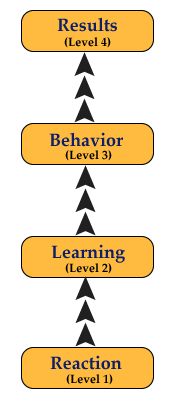
Kirkpatrick Model
I recently attended a meeting of the St. Louis Chapter of the American Society for Training and Development (ASTD) to listen to a presentation on the Kirkpatrick model of training assessment, offered by Jim Kirkpatrick, the son of the model’s creator — Don Kirkpatrick. Jim’s major point was that most training departments fail to measure learning outcomes at Levels 3 and 4 of the model. Without detailing the Kirkpatrick model’s four levels of analysis, the following are Jim’s definitions:
Reaction: involves what training participants thought of the training
Learning: the knowledge, skills, and attitudes gained through the training
Behavior: the degree participants apply what they learned on the job
Results: the business results gained
Suffice it to say that the model provides a unique framework on how to assess the learning outcomes of training. However, practitioners are prone to overlook a key issue in measuring learning. I previously noted the following about the Kirkpatrick model.
It is not a stretch to contend that Level 4 measurement is as much about organizational learning and change management as it is about individual learning. In the e-Learning Guild survey on measurement practices, Roy Pollock characterizes this situation as the “Catch-22” for training and development. He notes that, “assessment of on-the-job application and results is as much or more an assessment of the transfer climate…as it is of the quality of the instruction” (p. 167).
Based on what I heard from Jim Kirkpatrick as well as Nick Denardo, a presenter from Edward Jones’ strategic learning services group, the point about organizational learning also applies to Level 3 measurement, to the extent that existing organizational practices either facilitate or impede application of competencies and sharing of knowledge learned from formal training, whether on-the-job, or just informally.
Read the rest of this entry »
 1 Comment |
  e-Learning 2.0, Learning Experience | Tagged: e-Learning, e-Learning 2.0, eLearning, elearning 2.0, kirkpatrick model, Social Media |
  Permalink
 Posted by Larry Irons
December 11, 2008
 Dan Saffer’s recent book, Designing Gestural Interfaces, makes you think anew about the hand dryers and faucets in public restrooms that respond to waving hands. In fact, Dan notes that gestural interfaces are currently found in specialized products paired to specialized activities in specialized environments. As he observes,
Public restrooms are currently a great example of this, but other spaces could easily take on this sort of “hothouse” environment. The next likely place for such experimentation is kitchens: they feature lots of activities, plus a contained environment with tons of specialized equipment (pp. 160-161)
Designing Gestural Interfaces is the first attempt I’ve seen to provide an in-depth discussion of the challenges in designing devices that people control through gesturing. Although it isn’t the central point of the book, Dan discusses restroom interfaces that wet hands, dry hands, flush toilets, and dispense SaniSeats. And one of his example photographs is notated, “Apparently, public restrooms are excellent places to find gestural interfaces.”
Read the rest of this entry »
1 Comment | Experience Design, Innovation, Ubiquitous Computing, User Experience | Tagged: Dan Saffer, design research, gestural interface, gestures, metaphor | Permalink
Posted by Larry Irons
December 5, 2008

A month ago, Don Bartholomew asked the question, “Is 2009 the Tipping Point for Social Media accountability?” Don summarized the meaning of his question about accountability as follows:
So far, the spirit of experimentation has provided a sort of ‘get out of jail free’ card with respect to having to demonstrate the value of digital and social media programs and initiatives. It looks like 2009 will change all that due primarily to three factors:
– the widespread awareness of social media use in a business context
– the economy
– the economy
In a similar tone, Peter Kim recently took up the issue of return on investment (ROI) of social media. His thoughts on the topic were a response to a post by Lewis Green. Lewis offers a distinction between focusing on ROI and focusing on business Value as two different, though complementary, ways of addressing the importance of social media to business.
Read the rest of this entry »
3 Comments | Brands, Customer Communities, Innovation, Social Media, Web 2.0 | Tagged: Add new tag, ROI, Social Media, social media marketing, tipping point, VRM | Permalink
Posted by Larry Irons
December 1, 2008

In recent posts I discussed different gaps, from the community gap in particular to the encompassing engagement gap. Each of those discussions attempted to size up a disparity between the attention currently given to the importance of community and social media by companies and the reality of the commitment of resources to them based on recent research in the United States and Europe.
We hear a lot of discussion these days about Web 2.0 and social media, especially on whether adoption is driven by demographics, lifestyle, or something else. Recently, while reading Marketing Metaphoria by Gerald Zaltman and Lindsay Zaltman, it struck me that regardless of the patterns of Web 2.0 and social media adoption, the applications tap into basic sensibilities for connection that we all share, regardless of age and lifestyle. As I note below, a sense of connection is an example of a deep metaphor that the Zaltmans discuss in relation to people, products, and brands.
Deep metaphors underlie the way people understand the context of problems they face in their everyday lives. Though the concept of deep metaphor was initially outlined in Lakoff and Johnson’s book Metaphors We Live By, Marketing Metaphoria takes it a step further by developing useful techniques for exploring how deep metaphors affect the perception of brands and products and, by implication, how to approach the say-mean gap in design research.
Read the rest of this entry »
2 Comments | Brands, Customer Communities, Experience Design, Innovation, User Experience | Tagged: brand, community, engagement, groundswell, IA, insights, marketing, metaphor, say-mean, talk out loud, usability | Permalink
Posted by Larry Irons
November 18, 2008
 At least since publication of the Cluetrain Manifesto, with its meme that markets are conversations, observers noted the importance of what customers say about a brand, online and off — but especially those online. However, a somewhat subtler point from Cluetrain is increasingly relevant to brands and social media. The point was made in the book’s Thesis 39: “The community of discourse is the market.” In fact, the thesis actually consists of several ancillary ones: Read the rest of this entry »
3 Comments | Brands, Customer Communities, Customer Experience, Experience Design, Social Media, Web 2.0 | Tagged: brand, cluetrain, dialogue, emotion, Social Media, Web 2.0 | Permalink
Posted by Larry Irons
November 11, 2008

Whirlpool CentralPark Connection
I’ve been meaning to write about Dan Saffer’s Masters Thesis since reading it a couple of years ago. A recent post by Mike Kuniavsky provides an opportunity to do so. Also, it appears that Dan left his position at Adaptive Path to found Kicker Studio, a product design company. In The Role of Metaphor in Interaction Design, Dan noted that metaphors help users/customers understand new products and services by providing cues that orient and personify the experience of the familiar with the new.
In other words, metaphors help us understand one thing in terms of another by highlighting similarities between the two, while at the same time implicitly recognizing differences. Dan also added that metaphors introduced to facilitate adoption of a new product can also limit its innovation in other ways. He specifically pointed to the Workspace is a Desktop metaphor, which conceptualizes the computer as an office tool primarily. I would add that the metaphor contributed to the myth of the paperless office by obscuring the differences between desktops and graphical user interfaces. Specifically, Dan contended that,
it could be argued that the desktop metaphor has hindered the development of ubiquitous computing as much as some hardware factors (p.22).
At the same time, he observed that the desktop metaphor was much more effective in gaining the widespread adoption of computers when compared to the previous metaphor, i.e. computers as programming environments. He recommended that whenever designers use a metaphor in a new product they need to begin with what is new, the subject of the metaphor, rather than what the metaphor refers to. In other words, don’t force functionality into a metaphor. Use the metaphor to support a concept rather than the other way around. The point builds on the design principle of Cooper, Reiman, and Cronin in About Face 3.0 to, “Never bend your interface to fit a metaphor” (p. 279).
Read the rest of this entry »
14 Comments | Customer Experience, Experience Design, Ubiquitous Computing, User Experience, Web 2.0 | Tagged: Ceiva, clutter, Experience Design, intelligent refrigerator, metaphor, Ubiquitous Computing, whirlpool | Permalink
Posted by Larry Irons
October 22, 2008
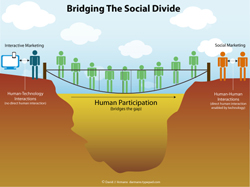 David Armano recently made a distinction between interactive advertising and social media which he depicts in the image on the left. He noted that many companies mistake interactive advertising with social media and notes that the two differ in the place of PEOPLE in the strategy. Specifically, David points out that interactive advertising involves Human-Technology Interactions. Whereas, social media involves Human-Human Interactions enabled by technology.
Read the rest of this entry »
6 Comments | Brands, Community 2.0, Experience Design, Social Media, Web 2.0 | Tagged: community, interactive advertising, Persona, social media marketing | Permalink
Posted by Larry Irons
October 20, 2008

The image on the left was used by Paul Dunay over at Marketing 2.0 in a recent post on digital signage. Paul notes that a recent Razorfish survey ranked digital signage (32 percent) as only second to mobile (51 percent) in importance as an emerging media channel. He also takes note of examples of new media channels that combine the two, mobile and digital signage.
Read the rest of this entry »
2 Comments | Social Media, Ubiquitous Computing, Web 2.0 | Tagged: digital signage, Social Media, Ubiquitous Computing, Web 2.0 | Permalink
Posted by Larry Irons
October 16, 2008
 Skilful Minds reminded readers about place-based story experiences like [murmur] recently after I visited the Missouri Botanical Gardens (MoBot) to see the Niki exhibit. The Niki exhibit showed forty mosaic sculptures done by Niki de Saint Phalle (1930 – 2002). Each concept used cell phones to either allow visitors to places to share stories about the place, as in [murmur], or allow visitors to listen to stories about specific exhibit items, as in the Niki exhibit.
Yanko Design showcased a design recently called touched echo developed by Markus Kison. Touched echo makes a place-based story experience available to visitors without the use of devices like cell phones. Although the technology was anticipated in an early experiment by Laurie Anderson called the Handphone Table, applying it to place-based stories is a new and innovative experience design. The design works by using bone conduction for hearing rather than transmitting audio waves through the air.
Read the rest of this entry »
Leave a Comment » | Cool Entries, Experience Design, Innovation, Social Media | Tagged: bone conduction, exhibit, Experience Design, Innovation, Social Media | Permalink
Posted by Larry Irons
October 3, 2008
Leave a Comment » | e-Learning 2.0, Learning Experience, Social Media, v-Tags, Web 2.0 | Tagged: 2d codes, devlearn08, e-Learning 2.0, mlearning, QR codes, v-Tags, visual tags, Web 2.0 | Permalink
Posted by Larry Irons
October 1, 2008
 Keeping up with social media is a real challenge these days. However, one theme seems constant whenever you read blogs about social media, especially among marketers and so-called optimizers who target, target, target to drive, drive, drive customers to their client’s social media asset, i.e. video, blog, community, etc. You would think advocates of social media are Rowdy, Gil, Jed, or one of the other actors on Rawhide.
Read the rest of this entry »
1 Comment | Brands, Customer Experience, Experience Design, Social Media, User Experience, Web 2.0 | Tagged: customer engagement, Experience Design, SEO, Social Media, social media optimization, targeting, Web 2.0 | Permalink
Posted by Larry Irons
September 26, 2008
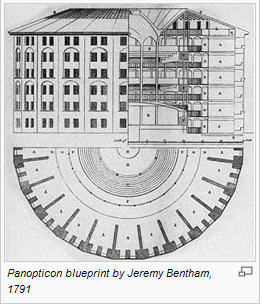 Peter Kim offers an interesting observation on the way social networking relates to the qualities of Jeremy Bentham’s Panopticon and the insight offered by Michel Foucault that Bentham’s design served as an exemplar for organizational discipline in the industrial age. Peter notes that Bentham’s design made prisoners uncertain whether the prison guards were watching their behavior at any particular moment. He also points out that the design of modern cube farms in offices not only foster collaboration but also afford observation by managers and peers.
Read the rest of this entry »
5 Comments | Collaboration, Community 2.0, e-Learning 2.0, Enterprise 2.0, Social Media, Social Networks, Web 2.0 | Tagged: e-Learning 2.0, elearning 2.0, panopticon, social networking, Web 2.0 | Permalink
Posted by Larry Irons
September 25, 2008
 I don’t usually discuss books or reports without contextualizing the discussion. However, I’ve just begun reading a book that merits mention before digesting how it fits either strategically or tactically with experience design issues.
Skilful Minds first discussed virtual anthropology several years ago noting the following.
The term points to the ability of customer researchers to now tap into the stories about personal experience that increasing numbers of people are providing online…But, keep in mind that the people offering their stories and experiences for your edification are not doing it for you.
Read the rest of this entry »
3 Comments | Customer Communities, Digital Ethnography, Ethnography, Experience Design, User Experience | Tagged: Experience Design, second life, virtual anthropology, Web 2.0 | Permalink
Posted by Larry Irons
September 18, 2008
 Ross Mayfield of SocialText recently pointed to a longstanding issue involving the relationship of organizational practices and organizational processes. He offered a discussion of distributed collaboration and community, specifically on the question of which organizational stakeholder is the most effective leader of community (internal and external) initiatives. Ross suggests that even though we may see the emergence of a Chief Community Officer to align and coordinate internal and external communities, communities are more likely to arise around organizational processes as 360 degree process communities.
In my view, approaching distributed collaboration from the standpoint of community alone, especially communities internal to the enterprise, is overly restrictive. Collective understanding and collaborative understanding, as Thomas Vander Wahl makes clear, are different parts of what he refers to as the social sofware stack. Without getting overly picky, let me agree with Ross’ point that the development of internal communities in enterprises will most likely occur around the way process owners manage routine work and its exceptions. Nevertheless, the distinction Ross makes, following Mike Gotta, about the difference between processes (how work is supposed to get done) and practices (how work actually gets done) really indicates a need to keep in focus the range of connections and interactions that social software enables.
Read the rest of this entry »
9 Comments | Collaboration, Community 2.0, e-Learning 2.0, Enterprise 2.0, Innovation, Social Media | Tagged: Collaboration, Community 2.0, Enterprise 2.0, Social Media, social software, Web 2.0 | Permalink
Posted by Larry Irons
August 29, 2008
 A few weeks ago, we drew from the 2008 Tribalization of Business Study, sponsored by Beeline Labs, Deloitte, and the Society for New Communications Research, to discuss the gap between the importance many enterprises attribute to the development of communities and the accompanying investment in that engagement strategy, whether focused on internal stakeholders, or externally on customers.
We noted that the findings of the Tribalization study point to a Community Gap. Yet, drawing from Rachel Happe, we also pointed out the differences between the conversations characterizing social media and the conversations of a community. The distinction is important to keep in mind when considering an overall strategy for connecting with and engaging people online, whether they are employees, suppliers, or customers. After reading two recent research efforts, one from Fleishman-Hillard and the other from Forrester Research, it is clear that the Community Gap is one manifestation of a larger gap, the Engagement Gap.
Read the rest of this entry »
6 Comments | Brands, Community 2.0, Customer Communities, Customer Experience, Experience Design, Social Media, Web 2.0 | Tagged: Customer Experience, engagement, Social Media, Web 2.0 | Permalink
Posted by Larry Irons
August 27, 2008

La Cabeza
We initially discussed place-based stories back in 2006, noting the way [murmur] provided people experiencing a place to add a story about their engagement with it. To listen to the stories, visitors to that place simply called a number on their mobile device.
I was reminded of the [murmur] service this past weekend while walking through the Missouri Botanical Gardens(MoBot) here in St. Louis. MoBot is hosting the Niki exhibit, showing forty mosaic sculptures done by Niki de Saint Phalle (1930 – 2002). Each sculpture is assigned a unique number that corresponds to an audio message for that work. For example, La Cabeza information is available at (314) 558-4357 11#.
Read the rest of this entry »
2 Comments | Experience Design, User Experience | Tagged: Experience Design, murmur, niki | Permalink
Posted by Larry Irons
August 13, 2008

For those who think discussions of semantic value and meaning are pointless, with no relationship to technology adoption, you may want to skip this post.
We first discussed visual tags in 2006. Many people today refer to them as 2d barcodes. However, a crucial difference exists between what things are like and what they in fact are. Calling visual tags (v-Tags) 2d barcodes is like calling YouTube a video database, Flickr a photo database, or Del.icio.us a favorites list. Literally, the description is accurate. Functionally, it is meaningless. Read the rest of this entry »
Leave a Comment » | Community 2.0, e-Learning 2.0, Experience Design, Innovation, Ubiquitous Computing, v-Tags, Web 2.0 | Tagged: 2d barcode, Experience Design, folksonomy, m-learning, mlearning, mobile experience design, mobile learning, social media marketing, Ubiquitous Computing, v-Tags, visual tags, Web 2.0 | Permalink
Posted by Larry Irons



 I received an email alert from the
  The eLearning industry is taking a step into


 Skilful Minds