August 10, 2009
 About a month ago I read What Would Andrew Do?, an unbook by Jay Cross and friends. I’ve mentioned Jay’s work in previous posts dealing with elearning 2.0 and collaboration in informal learning. In particular, its important to remember that focusing on informal learning doesn’t mean we must disregard the relevance of formal learning because learning is never 100% formal or informal.
However, the term scalable learning probably does require a bit of clarification. After all, isn’t elearning supposed to scale to the size of the learning group and remain available when they need it, where they need it, as long as they are connected to the Web? Well, yes–and it does pretty much. Nevertheless, instructional designers too often fail to incorporate emergent learning requirements of the organization, the enterprise, into their learning architecture largely because the approaches used to evaluate learning content (whether elearning, blended, or instructor-led) do not incorporate assumptions about the larger ecosystem’s need for the co-creation of knowledge.
The concern for whether the learner is exposed to every thread of content in every course, and assessed for mastery of the information, tends to predominate design thinking about learning, and for compliance training sometimes this is required. However, too often, instructional design fails to focus on whether the learning scales to support the learner’s ability on-the-job to recognize a problem as a particular kind of problem, much less provide the ability to find the learning content that provides a solution.
I don’t intend to delve here into the minutiae of distinction possible between types of learning. Suffice it to say that when a learning architecture supports all types of learning along the range of formal, non-formal, and informal experience, it must design formal learning in small enough chunks to serve as resources for non-formal and informal learning activities. It also means that the knowledge created using non-formal learning (whether mentored or accomplished in collaboration with peers), or informal learning taken on its own, needs to become a performance resource in developing new formal learning content.
Jay contends that the performance challenges facing organizations are most aptly conceptualized as a learnscape, a concept initially articulated by John Seely Brown and Paul Duguid. In the August 2009 issue of Chief Learning Officer magazine, Jay offers the following synopsis.
Learnscapes are the factory floor of knowledge organizations. The “scape” part underscores the need to deal at the level of the learning environment or ecology…The “learn” part highlights the importance of baking the principles of sound learning into that environment rather than leaving it to chance.
John Hagel sees learnscapes as part of a global transformation of industrial society that he, John Seely Brown, and Lang Davison call the Big Shift: the move from institutions designed for scalable efficiency to institutions designed for scalable learning. Hagel’s thinking is relevant since, as I explain below, Jay uses the Push/Pull distinction to demarcate formal and informal learning. The basic insight is conveyed by Hagel, Brown, and Davison in their thoughts on Measuring the Big Shift:
Companies must move beyond their fixation on getting bigger and more cost-effective to make the institutional innovations necessary to accelerate performance improvement as they add participants to their ecosystems, expanding learning and innovation in collaboration curves and creation spaces. Companies must move, in other words, from scalable efficiency to scalable learning and performance. Only then will they make the most of our new era’s fast-moving digital infrastructure.
The participants that Hagel, Brown, and Davison refer to consist of consumers, customers, partners, and employees using social media to talk about, talk to, and engage the products and services, i.e. brands, that an enterprise markets. Don’t misunderstand the focus on performance in the discussion of scalable learning. It isn’t about the traditional focus on efficiency, pursuing ever leaner processes for the sake of officially recognized best practices. Rather, the focus is on creating the knowledge needed to adapt to emergent challenges and manage the flow of that adaptation through the enterprise’s ecosystem. For learning architecture it begins with understanding the importance of keeping the focus on distinctions between push and pull learning.
Read the rest of this entry »
 3 Comments |
  Change Management, Collaboration, e-Learning 2.0, Enterprise 2.0 | Tagged: Big Shift, elearning 2.0, Enterprise 2.0, informal leaning, learnscapes, Push/Pull, socia network, Social Business Design, social computing, unbook |
  Permalink
 Posted by Larry Irons
August 1, 2009

Thanks to Tony Karrer, Skilful Minds is now a Featured Source for the eLearningLearning Community. The focus on eLearning offered here so far covers issues in experience design for the learning process. As the influx of social computing into the learning processes of organizations continues, the focus of Skilful Minds’ concern with eLearning is shifting to targeted discussions on how to design for effective informal learning experiences within an ecosystem of learners.
Jay Cross calls the domain a Learnscape, a design approach for developing co-creation, innovation, and self-service learning to shape the relationship between knowledge work and informal learning. As our discussions of social business design imply, the focus on learning and the social software stack needs to extend beyond the edge of organizations to their larger ecosystems, including consumers, customers, and strategic partners.
1 Comment | e-Learning 2.0, Learning Experience, Social Media | Tagged: informal learning, Learning Experience, learnscape | Permalink
Posted by Larry Irons
July 15, 2009

Social Media Snake Oil?
Does your organization approach using social media in its business as something to fear or as something to evangelize? Several recent observers note that incorporating social media into business involves changing the culture underlying communication patterns and decision-making in many large organizations.
Amber Naslund, for instance, tells us that adopting social media means changing the mindset on how to do business. In particular, she says using social media in business means “giving your customers a visible, valuable say in how you do things, and having the faith that doing that is just good business.” On the other hand, Caroline Dangson, of IDC contends enterprises aren’t yet sold on social media and that “there are executives still fearful of the transparency that comes with the social media spotlight.” Specifically, Caroline says that,
Corporate culture has everything to do with adoption of social media. I believe the number one factor preventing full adoption of social media is the lack of executive trust in employees. This culture is about control and creates a workplace of silos. This type of workplace is not set up to be social and the silos are barriers to worker productivity.
So, here social media sits, between fear and faith. Needless to say, the truth about social media’s implications for business design lies somewhere in the middle. The fact of the matter, as Todd Defren tells us, is that we need to begin seriously discussing “how Social Media Thinking will impact the greater whole of the company.”
As noted in an earlier post, keeping in mind the distinctions between formal, process-oriented organization and informal, practice-based organization is crucial in thinking through the collaborative challenges posed by social software for enterprises and designing for the experiences supported. We can learn a bit about the complexity of the challenges involved by considering a recent framework offered on social business design by the Dachis Corporation team and discussing the way it relates to a recent report on an experiment in enterprise social media at the Social Computing Lab of HP Laboratories.
Read the rest of this entry »
8 Comments | Brands, Change Management, Collaboration, Innovation, Social Business Design, Social Networks, Web 2.0 | Tagged: Customer Experience, Enterprise 2.0, Experience Design, Social Business Design, Social Media, socialCRM, Web 2.0 | Permalink
Posted by Larry Irons
July 7, 2009
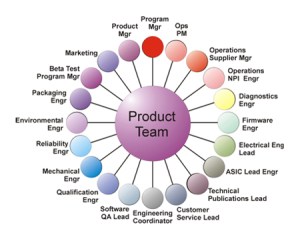
David Armano recently asked the question, Is the Hub and Spoke Model Adaptable? Anyone who ever worked on a project team in a large organization, especially corporate enterprises, probably recognizes the hub and spoke team design depicted in the graphic above. In this post I take a closer look at the hub and spoke design’s purpose in hierarchical, bureaucratic, organizations–the kind associated with industrial society. Our next post discusses how David answered his question and what an adaptable hub and spoke model implies for social business design.
Project management, typically consisting of one or more team leads clustered in the hub, considers the failure of any spoke’s functional work practices to align with approved best practices as evidence of process ignorance, a failure of competence in following the detailed process requirements in the team’s project plan, not a failure of the organization’s adaptive capability. The hub and spoke model’s basic idea is that a matrix-organization, consisting of cross-functional project teams, optimizes the traditional hierarchical organization by adding increased flexibility in responding to market demands for innovation in products and services, and maintaining adherence to a standard management process. However, as Rob Cross and Robert Thomas observe in their recent book, Driving Results Through Social Networks,
…most projects and processes are enabled by productive networks that form among some (but not all) team members in combination with relationships that bridge to key resources and expertise outside of the team.
In other words, much of the collaborative effort going into innovation projects also involves social networks that aren’t part of project teams. Instead, these networks emerge from relationships with others in the enterprise, or from outside friends and associates. Perhaps this is one of the reasons that some research into geographically distributed teams shows that on average, only 75% of the employees on any given distributed team agree about who is, and who is not, on their team. The challenge increases in importance as project teams form and disband more rapidly to manage risk and opportunity, thereby increasing the already fuzzy distinctions of formal organization, i.e. official teams, and informal organization, i.e. social teams.
Ross Mayfield summarized the point well in the following observation:
Process is “how work should be done.” And Practice is “how work is actually done.” When process fails (exceptions), people use practice to fix things. When process doesn’t exist, practice fills the void. While people don’t realize it when they engage in practice, they actually are tapping into community — an informal social network within or beyond the enterprise to discover expertise and get things done. The problem is that we haven’t had the tools to support good practice. The problem is that we haven’t developed the group memory around practice that creates institutional leverage. In fact, we still design organizations to prevent practice and cultures that hoard knowledge and communities.
I suggest that the real value of social business design comes from the promise it holds for enabling management practices to develop to deal with the following fact: Social networks do not respect organizational walls, they never did.
Shared experience, not just shared information, is fundamental to the social networks underlying collaboration and innovation. Many, if not most, employees don’t only need to get to know one another through reputation systems, like who people tag as possessing expertise. As Thomas Vander Wal continues to point out, comfort with one another is needed to develop a shared experience that encourages the open sharing of information.
Collaboration means getting to know that other employees possess expertise on this or that topic, but also developing comfort with one another by sharing significant symbols relating to self, family, friends, and social activities, thereby understanding one another as people. Shared experience with co-workers and customers is a key factor in innovative business practices. It is especially important to multichannel collaboration.
Read the rest of this entry »
23 Comments | Brands, Change Management, Collaboration, Experience Design, Social Business Design, Social Networks | Tagged: Change Management, Enterprise 2.0, Experience Design, project management, social business, social capital, social software stack, Web 2.0 | Permalink
Posted by Larry Irons
May 28, 2009
Vendor Relationship Management (VRM) is a term used by Doc Searls and other members of ProjectVRM to distinguish market relationships between vendors and consumers where the latter gain increased control over that commercial relationship. Building on the VRM concept, Jeremiah Owyang recently noted that VRM offers a potential future for public relations agencies in which the future of PR is in representing communities rather than brands. As Doc recently declared,
We therefore resolve to avoid all relationships in which the privileges of loyalty are determined entirely by the seller, and to construct new terms and means of engagement that will work in mutually constructive ways for both customers and sellers, for the good of all.
So, in the spirit of the Declaration of Customer Independence recently outlined by Doc, I offer the following turn of the century anecdote for thinking about Customer Managed Relationships (CMR).
Read the rest of this entry »
6 Comments | Community 2.0, Customer Communities, Customer Experience, Social Networks | Tagged: Community 2.0, Customer Communities, customer community, customer managed relationships, Experience Design, personalization, social network, social networking, vendor relationship management, VRM | Permalink
Posted by Larry Irons
May 20, 2009
 I first took real notice of the term “social business” in a post early this year over at Peter Kim‘s blog. The concept of social business is not limited to those enterprises seeking to “generate social improvements and serve a broader human development purpose,” though these are certainly admirable goals. Rather, social business is increasingly discussed as a frame of analysis for considering the business implications of large numbers of people using web 2.0 technologies, especially social media, within corporate enterprises as employees, or outside them as customers.
Channels, policies, processes, touch points and transactions are increasingly viewed as parts of the social experience organizations use to engage employees in collaboration, and customers in conversation. The common goal of the discussion involves transforming business practices to incorporate social relationships into the value proposition to customers and other stakeholders.
My recent reading of Wired to Care by Dev Patnaik (with Peter Mortensen) provided some basic insights for me in thinking about the development of social business practices. I highly recommend it to anyone with an interest in the intersection of experience design and organization. The book explores the concept of empathy in a manner that speaks to the social business discussion by pointing out that the result of a transformation is more than adoption of new technologies such as social media.
Wired to Care offers an approach to organizing business as well as creating design insights on how to engage customers to improve products and services. One of my earliest posts on Skilful Minds, Break the Golden Rule with Customer Dialogue Support, offered the following observation,
Many “customer care” approaches call for treating customers the way you’d like to be treated—the so-called Golden Rule. Treating customers the way we, as service providers want to be treated implies that we inherently know what’s best for them. A customer dialogue approach alternatively assumes that customers know, or can quickly learn, what’s best for them as individual customers. We need to treat customers the way their actions indicate they want, not the way we would want to be treated as a customer.
Reading Wired to Care persuaded me that my previous point only moved the discussion a part of the way to an understanding of the nuances of the Golden Rule for business. Wired to Care offers an interesting point of view on the limitations inherent in the traditional understanding of the Golden Rule, while contending that a full appreciation of it reveals truths about us as individuals, and our relationship to organizations, whether as employees or customers. It outlines three levels of the Golden Rule:
- “Do unto others as you would have them do unto you” — the most basic level with limited efficacy unless people share the same view of the world
- “Do unto others as they would have done to them” — requires increased empathy to distinguish the wants and needs of individuals
- “Do unto each other as we would have done unto us” — provides for empathy by focusing on “how we’d all like to be treated, inside the company and out,” yet also recognizes that good business practice might additionally require treating people “better than they expect to be treated”
Dev contends that the third level of the Golden Rule provides a basis for integrating empathy into the everyday practices of organizations. Though he does not use the term social business, Dev’s analysis offers a foundational strategy for implementing social business through the concept of an Open Empathy Organization.
Read the rest of this entry »
9 Comments | Brands, Change Management, Experience Design, Innovation, Social Business Design | Tagged: brand, Customer Experience, dev patnaik, empathy, empathy with customers, Experience Design, Golden Rule, open empathy organization, social business, wired to care | Permalink
Posted by Larry Irons
April 20, 2009

- The Cynefin Framework
As noted in a previous post, the promises made by brands are increasingly judged on whether they converge with the customer experience across channels of service in organizations. The challenge is a longstanding one for all organizations. However, the increasing adoption of social media makes the challenge more pressing as word of mouth (WOM) from customers, suppliers, competitors, or others amplifies their ability to communicate their experience with your brand to others. Word of mouth communities and networks using social software are increasingly spread over regional, national, and international borders, making them much more important to those who market branded products and services, online and off.
Speaking the language of customer-centricity is not good enough. Companies must talk-the talk and walk-the-walk for brand strategy. Brand strategies are most effective when based in the design and delivery of business services themselves. Listening to the conversations people engage online about a topic (such as your brand), and eliciting the participation of those people in the development and refinement of products and services, are two key parts of an experience design strategy. Even though you may think this is a “Duh!” insight, consider recent findings on the engagement gap.
PriceWaterhouseCooper’s 12th Annual CEO Survey recently reported that most CEOs,
…believe that data about their customers (94%), brand (91%) and employees (88%) are important or critical to long-term decision-making. However, strikingly low percentages of CEOs say they have comprehensive information in these and other critical areas that contribute to organisational agility. Just 21% have comprehensive information about the needs and references of customers and clients. Less than one third feel they have all the information they need about reputation (31%) and the views and needs of employees (30%).
Not surprisingly, the ability to anticipate customer needs is the widest gap between the information CEOs report they need to make decisions about the long-term success of their businesses, and what they currently possess. This post explores the Cynefin (pronounced cunevin) Framework as a helpful approach for thinking about the importance of dialogue with customers in efforts to bridge insight and action.
Read the rest of this entry »
Leave a Comment » | Customer Communities, Customer Experience, Experience Design, Social Media, Social Networks | Tagged: brand, co-creation, community, Customer Experience Management, Cynefin Framework, dialogue, Experience Design, Social Media, WOM, word of mouth | Permalink
Posted by Larry Irons
April 6, 2009
 The topics discussed at Skilful Minds fall in a range of challenges involved in translating strategic business goals, and the complex needs of people, into exceptional experiences, for employees who provide products and services and those who consume them, whether the latter are customers, users, learners, or just plain people. Commentators and practitioners of experience design tend to focus on the latter while largely ignoring the former. A few recent posts by influentials speak directly to these concerns and merit specific attention for their insights into experience design and brands.
The underlying theme is that brands are not simply about the way customers view products and services. The way employees engage customers in the design, development, and delivery of those products and services is also crucial to brands. However, exhorting employees to live the brand and talk customer-centricity is a prescription for failure when isolated from transformational changes to a company’s engagement with customers.
Read the rest of this entry »
6 Comments | Brands, Change Management, Customer Experience, Experience Design, Social Media | Tagged: brand, Customer Experience, dialogue, Experience Design, PR 2.0 | Permalink
Posted by Larry Irons
March 18, 2009

Social Software Stack
The title for this post is drawn from a recent assessment of SharePoint 2007 offered on Thomas Vander Wal’s bog, Personal InfoCloud. Thomas’ post, as always, offers a unique point of view on what Enterprise 2.0 consists and, specifically, how SharePoint measures up. He isn’t offering his own formal assessment as much as reporting the stories clients and potential clients shared with him over the past couple of years. The social software stack, in particular the difference between collective understanding and collaborative understanding, frames Vander Wal’s perspective.
Given SharePoint’s widespread use, and the growing interest in applying social media applications to collaboration challenges in organizations, Thomas’ discussion deserves wider attention. His overall impression is well summarized in the following point.
SharePoint does some things rather well, but it is not a great tool (or even passable tool) for broad social interaction inside [the] enterprise related to the focus of Enterprise 2.0. SharePoint works well for organization prescribed groups that live in hierarchies and are focussed on strict processes and defined sign-offs. Most organizations have a need for a tool that does what SharePoint does well.
This older, prescribed category of enterprise tool needs is where we have been in the past, but this is not where organizations are moving to and trying to get to with Enterprise 2.0 mindsets and tools. The new approach is toward embracing the shift toward horizontal organizations, open sharing, self-organizing groups around subjects that matter to individuals as well as the organization. These new approaches are filling gaps that have long existed and need resolution.
In other words, SharePoint works well for situations in which defined groups need to reach a collaborative understanding of project requirements, their role in achieving those objectives, and what success means for the project. It works less well in providing resources allowing people across the enterprise, and across teams or departments, to discover connections with others and develop social relationships for networking together in ways that meet both personal and organizational challenges.
Read the rest of this entry »
12 Comments | Collaboration, Enterprise 2.0, Social Media, Web 2.0 | Tagged: e-Learning 2.0, elearning 2.0, Enterprise 2.0, social networking, twitter, Web 2.0 | Permalink
Posted by Larry Irons
March 2, 2009
 A recent Economist article discusses the relevance of Dunbar’s Number to friending in Facebook, and its relation to the size of social networks, especially networks of close friends. The article addresses a similar issue outlined in an earlier post here on the influence of influentials on Twitter, which focused on findings of a recent study by members of the Social Computing Lab of HP Laboratories .
Read the rest of this entry »
2 Comments | Social Media, Social Networks | Tagged: facebook, friends, social core, social media marketing, social network, social networking, twitter, Web 2.0 | Permalink
Posted by Larry Irons
February 23, 2009
 Good service is one of those experiences most of us recognize when we get it. Much of the time though, a good service experience is as much a result of how learnable the provider makes its business processes, the context of the service, as it is the products and services themselves. I discussed this a couple of years ago in a post on the importance of a dialogue strategy for customer experience management. A dialogue strategy builds on the assumption that companies learn more from customers when customers learn from them. More recently I noted that,
The increasing maturity and diffusion of social media over the ensuing years makes it clear that a dialogue strategy provides a coherent framework for communications, whether addressing collaboration, innovation, marketing, sales, support, or branding. The key to the process is understanding customers, attracting them, engaging them, and learning from them to improve products and services, thereby strengthening your brand…
Strategists increasingly recognize that listening to customers, engaging them in dialogue, and acting on what is learned lies at the heart of experience design’s relevance to brands, customers, and social media.
These insights are relevant to the current shift in focus for experience design, from primarily emphasizing the design of products to also emphasizing the design of services, as exemplified in Peter Merholtz’s recent series in Harvard Business online. Okay, you may ask, how does this all relate to eLearning and learnability?
Read the rest of this entry »
2 Comments | Collaboration, Experience Design, Learning Experience | Tagged: business process, call center, Customer Experience, e-Learning, eLearning, elearning design, Experience Design, learnability | Permalink
Posted by Larry Irons
February 2, 2009
The Museum of Lost Interactions opened in 2006, and many of you may know about it already because of the initial sensation it caused among prominent thinkers about technology like Bruce Sterling. However, for those who don’t, I thought you might want to. MoLi is located in the University of Dundee’s Interactive Media Design program. MoLi aims to raise public awareness of the history of interaction design.
Read the rest of this entry »
Leave a Comment » | Cool Entries, Experience Design, Social Media | Tagged: Experience Design, interaction archaeology, interaction design, lost interactions, social communicator | Permalink
Posted by Larry Irons
January 27, 2009

We Need A New Box
A recent report from the Chief Marketing Officer Council provides an interesting set of insights into the engagement gap. The engagement gap refers to the difference between the influence of the Internet in consumer decision making and the amount of spending, and effort, by corporations and government agencies in trying to interact with and shape the thinking behind those decisions.
The CMO Council report summarizes the overall results of the survey as follows:
What we are seeing is much stronger sensitivity to engage directly with customers and learn more about what shapes, influences and impacts purchasing decisions and intentions to do business. The move to quantify “customer affinity” and increase “customer advocacy” has become a new measure of marketing effectiveness…
Read the rest of this entry »
Leave a Comment » | Brands, Experience Design, Social Media | Tagged: brand monitoring, engagement gap, Experience Design, listening platform, social media marketing | Permalink
Posted by Larry Irons
January 27, 2009

P&G Social Media Lab
As part of an overall critique of self-oriented approaches to innovation, Skilful Minds first considered open innovation at Procter and Gamble back in 2006. The latter post is one of the most visited here.
Given my recent focus on transformation as a fundamental concern for those interested in design and innovation, the recent publicity about P&G’s Social Media Lab instantly drew me to take a look.
Read the rest of this entry »
2 Comments | Customer Communities, Innovation, Social Media, User Experience | Tagged: open innovation, P&G, procter & gamble, self-oriented innovation, Social Media, social media lab, user experience | Permalink
Posted by Larry Irons
January 16, 2009
Social Networks that Matter
Without going into links to specific posts, I’ve noticed a trend among many blogs I try to keep up with over the past couple of years. I can’t count the number of times I’ve seen prominent bloggers post publicly about having to pare down the list of RSS feeds they read, or tweets they respond to. Since Peter Kim’s blog is the most recent instance of the trend I’ll use one of his recent posts as an example of what I mean. Peter noted that he increasingly hears an echo chamber across social media blogs in which the same content, case studies, anecdotes, etc. gets repeatedly posted and commented on. More cynical observers might contend that the complaints about information overload from influentials is a little like strutting in front of a crowd. Nevertheless, it is difficult to dispute the point that attention is a scarce resource on the Web. So is engagement.
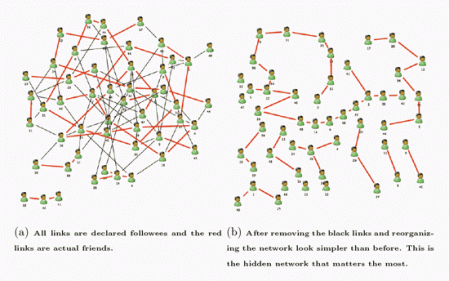
Ross Mayfield recently pointed to a study published by researchers at the Social Computing Lab of HP Laboratories that addresses the point succinctly by pointing to constraints on friendship in directed social networks such as Twitter. A directed social network is characterized by an absence of explicit reciprocity constraints, fifty people can follow one person without that person necessarily following any of them. First Monday’s most recent issue includes an article, Social Networks that Matter: Twitter under a Microscope, that reports on a study of Twitter users by Bernardo A. Huberman, Daniel M. Romero, and Fang Wu of HP Laboratories.
The authors analyzed data from 309,740 people using Twitter. They compared the network of interactions people actually engage in while using social computing technologies such as Twitter to the network of connections with whom one shares a social relationship. Networks of actual interaction are considered networks that matter by the authors.
By networks that matter we mean those networks that are made out of the pattern of interactions that people have with their friends or acquaintances, rather than constructed from a list of all the contacts they may decide to declare.
In other words, the research focused on reciprocity as well as connection in studying the social network of Twitter.
Read the rest of this entry »
13 Comments | Brands, Collaboration, Social Media, Social Networks, Web 2.0 | Tagged: Dunbar number, hidden network, influentials, reciprocity, Social Media, social network, social networks that matter, twitter, viral marketing, word of mouth | Permalink
Posted by Larry Irons
January 7, 2009

Bruce Nussbaum recently declared Innovation is Dead, initiating a lively discussion around the issue of whether one term for change is better than another.
Before listing out Bruce’s key points, it is important to recognize that he isn’t saying that innovation is unimportant. Rather, he is pointing to the necessity of approaching meaningful change as a transformation of relationships between people and institutions, not just innovation at the edges through altering the systems allowing us to manage products and services.
Following his initial post, Bruce summarized his thinking in succinct form.
1- Our institutions aren’t working. They are broken. Corporations, investment banks, health care, schools, universities, Congress, transportation. The current crisis is accelerating the breakdown in the major institutions of our lives that began in the 90s.
2- Digital technology is disintermediating every organization, eroding the role of all middle men and women, from ad agencies to college professors, from newspaper editors to hospital administrators, from political parties to savings banks. The shape of all our institutions is radically changing.
3- The power to create and participate is moving to the masses. Digital technology is giving everyone the tools to tinker again, to design and shape their learning, their working, their play. Craft is back in newly significant ways that we are just beginning to understand.
4- “Innovation” is inadequate as a concept to deal with these changes. You have “game-changing” innovation, which is big but rare and incremental innovation which is small but common. “Innovation” implies changing what is. “Transformation” implies creating what’s new. That’s what we need today, a huge amount of totally “new.”
5- Design is the answer. I use the term “transformation” to capture the immensity of the task ahead of us and to guide us in the magnitude of that task, but the actual tools, methodologies and, yes, philosophy of that mission is found within the space of design and design thinking.
Read the rest of this entry »
5 Comments | Experience Design, Innovation, Social Media, Web 2.0 | Tagged: change, deep metaphor, Innovation, nussbaum, socia media, transformation, zaltman | Permalink
Posted by Larry Irons
December 29, 2008
 As a previous post noted, assessing the business value of instructional design involves more than measuring the contribution of formal training to Level 3 and Level 4 outcomes defined in the Kirkpatrick model. Training professionals also need to understand and support informal learning processes, on-the-job and off, that enhance performance. Most of the learning that produces business value occurs informally, dealing with exceptions to formal business processes, yet most of the attention paid to learning is focused on formal training.
One can reasonably say that Web 2.0 applications, such as social software and social media, are changing the relationships between instructional designers and subject matter experts much like those between customer communities and product designers. Both increasingly involve situations of co-creation.
The emerging recognition of eLearning 2.0’s importance to enhancing collaboration and performance means that training professionals, especially instructional designers, can add value to their employer/client’s business by learning to facilitate and manage the co-creation of learning content with employees, or even customers. Anyone experienced in instructional design in recent years is familiar with the general challenge of co-creation whenever they use information content for course design ( slide shows, documents, etc.) that subject matter experts originally created as a resource for a presentation. The presentation content too often is substituted for observation and in-depth interviewing as a first step in analysis.
Such Rapid eLearning, though shifting content development toward the subject matter expert’s control, maintains the traditional role of training in incorporating design principles. The process of co-creation in eLearning 2.0, on the other hand, shifts control over development and distribution of learning content toward subject matter experts willing and able to share what they know, especially when they see other people who need to solve familiar problems.
Read the rest of this entry »
4 Comments | Collaboration, e-Learning 2.0, Innovation, Learning Experience, Social Networks | Tagged: co-creation, Customer Communities, e-Learning, e-Learning 2.0, eLearning, elearning 2.0, instructional design, kirkpatrick model, mzinga, social media measurement, social network, training, Web 2.0 | Permalink
Posted by Larry Irons

 Met
Met 





 Skilful Minds