December 5, 2008

A month ago, Don Bartholomew asked the question, “Is 2009 the Tipping Point for Social Media accountability?” Don summarized the meaning of his question about accountability as follows:
So far, the spirit of experimentation has provided a sort of ‘get out of jail free’ card with respect to having to demonstrate the value of digital and social media programs and initiatives. It looks like 2009 will change all that due primarily to three factors:
– the widespread awareness of social media use in a business context
– the economy
– the economy
In a similar tone, Peter Kim recently took up the issue of return on investment (ROI) of social media. His thoughts on the topic were a response to a post by Lewis Green. Lewis offers a distinction between focusing on ROI and focusing on business Value as two different, though complementary, ways of addressing the importance of social media to business.
Read the rest of this entry »
 3 Comments |
  Brands, Customer Communities, Innovation, Social Media, Web 2.0 | Tagged: Add new tag, ROI, Social Media, social media marketing, tipping point, VRM |
  Permalink
 Posted by Larry Irons
December 1, 2008

In recent posts I discussed different gaps, from the community gap in particular to the encompassing engagement gap. Each of those discussions attempted to size up a disparity between the attention currently given to the importance of community and social media by companies and the reality of the commitment of resources to them based on recent research in the United States and Europe.
We hear a lot of discussion these days about Web 2.0 and social media, especially on whether adoption is driven by demographics, lifestyle, or something else. Recently, while reading Marketing Metaphoria by Gerald Zaltman and Lindsay Zaltman, it struck me that regardless of the patterns of Web 2.0 and social media adoption, the applications tap into basic sensibilities for connection that we all share, regardless of age and lifestyle. As I note below, a sense of connection is an example of a deep metaphor that the Zaltmans discuss in relation to people, products, and brands.
Deep metaphors underlie the way people understand the context of problems they face in their everyday lives. Though the concept of deep metaphor was initially outlined in Lakoff and Johnson’s book Metaphors We Live By, Marketing Metaphoria takes it a step further by developing useful techniques for exploring how deep metaphors affect the perception of brands and products and, by implication, how to approach the say-mean gap in design research.
Read the rest of this entry »
2 Comments | Brands, Customer Communities, Experience Design, Innovation, User Experience | Tagged: brand, community, engagement, groundswell, IA, insights, marketing, metaphor, say-mean, talk out loud, usability | Permalink
Posted by Larry Irons
October 16, 2008
 Skilful Minds reminded readers about place-based story experiences like [murmur] recently after I visited the Missouri Botanical Gardens (MoBot) to see the Niki exhibit. The Niki exhibit showed forty mosaic sculptures done by Niki de Saint Phalle (1930 – 2002). Each concept used cell phones to either allow visitors to places to share stories about the place, as in [murmur], or allow visitors to listen to stories about specific exhibit items, as in the Niki exhibit.
Yanko Design showcased a design recently called touched echo developed by Markus Kison. Touched echo makes a place-based story experience available to visitors without the use of devices like cell phones. Although the technology was anticipated in an early experiment by Laurie Anderson called the Handphone Table, applying it to place-based stories is a new and innovative experience design. The design works by using bone conduction for hearing rather than transmitting audio waves through the air.
Read the rest of this entry »
Leave a Comment » | Cool Entries, Experience Design, Innovation, Social Media | Tagged: bone conduction, exhibit, Experience Design, Innovation, Social Media | Permalink
Posted by Larry Irons
September 18, 2008
 Ross Mayfield of SocialText recently pointed to a longstanding issue involving the relationship of organizational practices and organizational processes. He offered a discussion of distributed collaboration and community, specifically on the question of which organizational stakeholder is the most effective leader of community (internal and external) initiatives. Ross suggests that even though we may see the emergence of a Chief Community Officer to align and coordinate internal and external communities, communities are more likely to arise around organizational processes as 360 degree process communities.
In my view, approaching distributed collaboration from the standpoint of community alone, especially communities internal to the enterprise, is overly restrictive. Collective understanding and collaborative understanding, as Thomas Vander Wahl makes clear, are different parts of what he refers to as the social sofware stack. Without getting overly picky, let me agree with Ross’ point that the development of internal communities in enterprises will most likely occur around the way process owners manage routine work and its exceptions. Nevertheless, the distinction Ross makes, following Mike Gotta, about the difference between processes (how work is supposed to get done) and practices (how work actually gets done) really indicates a need to keep in focus the range of connections and interactions that social software enables.
Read the rest of this entry »
9 Comments | Collaboration, Community 2.0, e-Learning 2.0, Enterprise 2.0, Innovation, Social Media | Tagged: Collaboration, Community 2.0, Enterprise 2.0, Social Media, social software, Web 2.0 | Permalink
Posted by Larry Irons
August 13, 2008

For those who think discussions of semantic value and meaning are pointless, with no relationship to technology adoption, you may want to skip this post.
We first discussed visual tags in 2006. Many people today refer to them as 2d barcodes. However, a crucial difference exists between what things are like and what they in fact are. Calling visual tags (v-Tags) 2d barcodes is like calling YouTube a video database, Flickr a photo database, or Del.icio.us a favorites list. Literally, the description is accurate. Functionally, it is meaningless. Read the rest of this entry »
Leave a Comment » | Community 2.0, e-Learning 2.0, Experience Design, Innovation, Ubiquitous Computing, v-Tags, Web 2.0 | Tagged: 2d barcode, Experience Design, folksonomy, m-learning, mlearning, mobile experience design, mobile learning, social media marketing, Ubiquitous Computing, v-Tags, visual tags, Web 2.0 | Permalink
Posted by Larry Irons
July 20, 2008
Adam Silver, a Strategist at Frog Design, recently wrote an insightful article, “Calculated Design”, in the company’s online magazine — design mind. I want to discuss the article because it touches on several key issues relating to innovation and designing products and services for the experience of users/customers. Adam notes that as globalization and digitalization emerged in the 1990s the trend resulted in product and service interfaces with more culturally diverse and geographically distributed audiences and a fragmented market. The combination of these forces led designers to search for new methods to augment artistic intuition. Considerations of form and function also required attention to feel, features, and interactivity attuned to the needs, wants, and beliefs of specific users/customers.
As Adam observes, ethnography was one of the first new methods incorporated by design research to meet these challenges in the market. However, he thinks ethnography is, on its own, unable to provide the kind of information needed to validate product and service ideas across wide audiences. Read the rest of this entry »
12 Comments | Customer Experience, Experience Design, Innovation, User Experience | Tagged: empathic research, empathic research methods, empathic research strategy, empathy with customers, Ethnography, Experience Design, Innovation | Permalink
Posted by Larry Irons
July 14, 2008
At least since publication of the Cluetrain Manifesto, with its basic point that markets are conversations, the importance of customers, online and off — but especially those online, to innovation gained widespread recognition. Pointing out the importance of customer communities to sustaining innovation is not exactly a new insight. In recent years the term co-creation emerged to describe the process, whether applied to established companies or start-ups. However, understanding what leads customers to engage in co-creation is important. A story at Nokia Conversations points to a recent study sponsored by Nokia Beta Labs that offers a profile of the customers active in their community, framing the relationship as follows:
While on one side it seems cheap to release unfinished goods and ask for help. But at the same time, it’s amazing to involve eager customers who not only make the product even better than if we did it alone, but are all lined up to take the product they helped make… Read the rest of this entry »
1 Comment | Collaboration, Customer Communities, Innovation | Tagged: co-creation, Customer Communities, Innovation | Permalink
Posted by Larry Irons
July 8, 2008
Screencasts are effective ways to share ideas, images, concepts, experiences, and a range of information for a variety of purposes including eLearning, collaborative problem solving, or just fun. I just ran across a new technique for doing screencasts called a Flowgram. Eric Schonfeld over at TechCrunch describes it as,
…a full-screen player with what appears to be a screencast with a voiceover. Except that you can control the pages by scrolling up and down, watching any videos that might be on the page, or clicking on the live links (which takes you out of the Flowgram to that Website, but if you hit the back button it picks up where it left off). You can also add comments and share the Flowgram via a widget…It’s an interactive screencast, a way to synthesize the Web by pulling different pieces together The voiceover acts as the glue. It can be used for slide shows, travel guides, tutorials, sales pitches, or just to explain something to a friend.
I’ve signed up for the private beta access program so I can build a few Flowgrams of my own to get a better sense of how this tool compares to applications like Captivate or Camtasia. After briefly interacting with several of the Flowgrams available it looks quite promising. I like the ability to scroll pages as well as play videos embedded in pages presented in the Flowgram. I’m not sure why the developers decided to navigate out of the Flowgram when you click on a link that takes you to a page outside the Flowgram, rather than opening a window to view it, but when you click the back arrow the flow of the Flowgram seems to pick back up where you left it. Take a look at Flowgram for an overview.
Share this post…
 :
:  :
:  :
:  :
:  :
:  :
:  :
:  :
:  :
:  :
: 
4 Comments | Collaboration, Cool Entries, e-Learning 2.0, Innovation, Web 2.0 | Tagged: Collaboration, flowgram, Web 2.0 | Permalink
Posted by Larry Irons
July 7, 2008
Do you know who is on your team? It seems like an easy question for people who work in large corporations to answer. Reviewing Socialtext People recently led me to remember an interesting study I read a few years ago that reported rather surprising findings with significance for Enterprise 2.0, and to the lead-in question above. The study, largely ignored in the social networking literature, pointed to a clear limitation to collaboration in national and global corporations that organize teams geographically distributed.
Mark Mortensen and Pamela Hinds published a chapter titled, “Fuzzy Teams: Disagreement in Distributed and Collocated Teams”, in an edited collection called Distributed Work way back in 2002. The book itself contains an interesting range of studies on the challenges involved in organizing work across members of geographically distributed teams. However, it seems to me that Fuzzy Teams offers a key insight into the way Enterprise 2.0 applications, especially wikis, help to meet challenges in organizing distributed work that are often overlooked. Read the rest of this entry »
5 Comments | Collaboration, Enterprise 2.0, Innovation, Web 2.0 | Tagged: boundary spanning, distributed work, Enterprise 2.0, wikis | Permalink
Posted by Larry Irons
June 30, 2008
As a member of the boomer generation, a recent post by Stewart Mader on the use of Enterprise 2.0 at Wachovia caught my attention because it relates to a range of ongoing discussions on the relationship of age and innovative uses of technology in supporting collaboration.
Stewart points approvingly to a recent InformationWeek article on Wachovia’s use of wikis, blogs, and social networking to develop mutual mentoring between younger workers and senior staffers. Wachovia is assigning younger staffers to mentor senior staffers about the benefits of using collaborative networks. However, Stewart goes on to qualify the point of such mentoring with the following insight:
We often talk about how the millennial generation has an advanced grasp of these social and collaborative tools, but just half of the story in my opinion. I see enterprise 2.0 tools not as the exclusive domain of youth, but as a better connector for multiple generations, so that wisdom, tacit knowledge, and business know-how from the experienced can be shared with younger workers.
The point is bolstered by recent research, though with a couple of crucial caveats. Read the rest of this entry »
Leave a Comment » | Collaboration, Enterprise 2.0, Innovation, Web 2.0 | Tagged: digital divide, Enterprise 2.0, Millenials, Web 2.0, wiki | Permalink
Posted by Larry Irons
June 28, 2008
Wikis are largely about creating, organizing, and sharing knowledge. Most people think of textual and static graphic information created, organized, and maintained by groups of people when they consider what makes up a wiki. The integration of visualization tools is one of the more interesting developments in wikis recently though. As an example, the Thinkbase tool provides an ability to visually navigate and explore Freebase, an open, shared database of the world’s knowledge. The Thinkbase Blog is a good resource for learning about Thinkbase.
In fact, John Hosking recently provided an overview of how to use visual wikis. Read the rest of this entry »
7 Comments | Collaboration, Enterprise 2.0, Innovation, Web 2.0 | Tagged: Enterprise 2.0, visual wiki, Web 2.0 | Permalink
Posted by Larry Irons
April 30, 2008
Thomas Vander Wal recently offered an interesting discussion of how collective understanding and collaborative understanding differ, and why those differences are significant to social software, specifically in relation to folksonomy. Thomas’ concern is that many observers, and he points to the Wikipedia entry for folksonomy specifically, conflate collective understanding and collaborative understanding when considering folksonomy. He notes that, even though the two terms are similar, their differences manifest as distinct capabilities in social software.
…the term folksonomy was coined to separate tagging done in a collective manner (each individual’s contribution is held separate and collected or aggregated to build a fuller understanding, as the tagging is done by and from the individual reading the media for their own retrieval and is also share out with others). Collaborative tagging does take place and there is a need for it in certain situations, but it is not folksonomy.
First, Thomas makes a key point that remains unspoken when many people write about social software. Read the rest of this entry »
2 Comments | Collaboration, Enterprise 2.0, Innovation, Social Networks, Web 2.0 | Tagged: Collaborative Tags, Collective Tags, Enterprise 2.0, The Long Tail | Permalink
Posted by Larry Irons
January 27, 2007
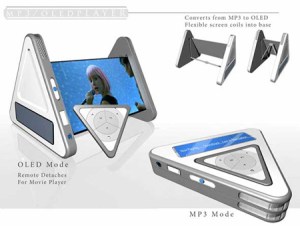
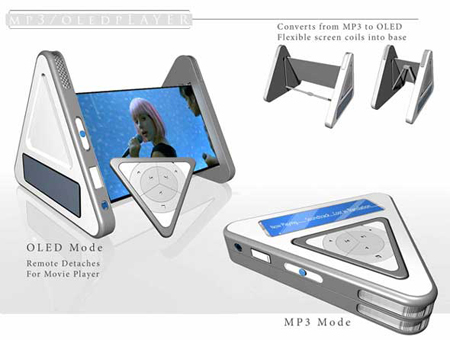
Designer Lisa Kohanski offers a futuristic design, perhaps not all that far off, for an MP3/video player. Yanko Design offers the following description of the device:
Tripod is not only a unique triangular MP3 player, but a movie player as well! To transform, turn your MP3 player upside down and pull the two halves apart while holding the release button. As the OLED screen uncoils, a hinge will unfold and lock, stabilizing the unit. Remove the MP3 control and it becomes the remote movie player remote. Speakers round the top triangle corner for optimum sound projection.
1 Comment | Cool Entries, Experience Design, Innovation | Tagged: Kohanski, OLED, Yanko Design | Permalink
Posted by Larry Irons
March 26, 2006
Yesterday I received my copy of the Working Knowledge series from Harvard Business School. Larry Huston and Nabil Sakkab, both executives for P&G., wrote one of the articles, “P&G’s New Innovation Model.” The authors note that, by the year 2000, the challenge for P&G of growing organically by 4 to 6 percent each year meant the equivalent of building a $4+ billion business annually. They note that P&G was able to meet those top-line growth challenges in the past by building global research facilities and retaining the world’s best talent. Yet, the authors indicate that by the year 2000 P&G recognized it could not support the necessary growth using the “invent-it-ourselves” model, what I’ve previously termed self-oriented innovation. Read the rest of this entry »
1 Comment | Customer Communities, Innovation | Tagged: Innovation, Self-Orientation | Permalink
Posted by Larry Irons
January 3, 2006
“The best companies find ways to tune in to customers’ voices every day,” The Three “Ds” of Customer Experience…
Focusing on how to engage customers in dialogue, how to converse with customers is among the greatest challenges, and opportunities, facing companies today. Conversing with customers requires a focus on their experience with existing products and services as well as the design of new ones. It means developing business processes to deliver products and services that are not self-oriented, but customer-oriented; not inside-out, but outside-in.
Customer Experience Management (CEM) is a term used by many people to describe the methods for developing customer-orientation instead of self-orientation in business processes. CEM is one of those terms offering something to lots of different people. As a result, it is sometimes confused with the very services it claims to offer management advice on applying. A recent series of posts on LivePath provide an interesting discussion on what makes CEM different from CRM, User Experience Design, and Experiential Marketing. If you employ these buzz words in describing the services your company offers, I strongly encourage a close reading of these posts by Leigh Duncan. Although I might quibble with some of the distinctions made within each functional area of CEM that Leigh outlines, the overall strategy for making sense of what CEM offers is sound.
Share this post…
: : : : : : : : : :
Leave a Comment » | Customer Communities, Customer Experience, Experience Design, Innovation | Tagged: CEM, CRM, Customer Experience Management, user experience | Permalink
Posted by Larry Irons
November 1, 2005
Booz, Allen, Hamilton recently reported on their Global Innovation 1000 research in “Money Isn’t Everything.” We briefly mentioned the report here. However, the findings are significant enough that an indepth discussion is needed.
So, why do I think the findings of the research are significant? Read the rest of this entry »
3 Comments | Brands, Customer Communities, Customer Experience, Innovation | Tagged: customer dialogue, Customer Experience, Innovation, product development, R&D | Permalink
Posted by Larry Irons





 Skilful Minds