To start let’s consider two distinctions about organizational processes. Following Sig over at Thingamy, two basic types of processes exist: easily repeatable processes (ERPs) and barely repeatable processes (BRPs).
ERPs: Processes that handle resources, from human (hiring, firing, payroll and more) to parts and products through supply chains, distribution and production.
BRPs: Typically exceptions to the ERPs, anything that involves people in non-rigid flows through education, health, support, government, consulting or the daily unplanned issues that happens in every organisation.
As I noted in Social Learning and Exception Handling, BRPs result in business exceptions and take up almost all of the time employees spend at work. Interestingly, much of the writing I see on Big Data is about making ERPs more efficient or making guesses about when to expect occurrences of a BRP. In other words, both goals are really about making coordination of organizational efforts more efficient and/or effective.
How organizations coordinate their activities is essential to the way they function. What makes sense for the organization’s internal processes may not make sense in its ecosystem, and vice versa. These are distinctions that analysts of Big Data sometimes fail to note and consider.
For example, in The Industrial Internet the Future is Healthy, Brian Courtney notes the following about the use of sensors in industrial equipment and the benefits derived from storing at big data scale.
Data science is the study of data. It brings together math, statistics, data engineering, machine learning, analytics and pattern matching to help us derive insights from data. Today, industrial data is used to help us determine the health of our assets and to understand if they are running optimally or if they are in an early stage of decay. We use analytics to predict future problems and we train machine learning algorithms to help us identify complex anomalies in large data sets that no human could interpret or understand on their own [my emphasis].
The rationale behind using data science to interpret equipment health is so we can avoid unplanned downtime. Reducing down time increases uptime, and increased uptime leads to increases in production, power, flight and transportation. It ensures higher return on assets, allowing companies to derive more value from investment, lowering total cost of ownership and maximizing longevity.
In other words, Courtney’s analysis of the big data generated from sensors that constantly measure key indicators about a piece of equipment assumes the data ensures a decrease in downtime and an increase in uptime resulting in increases in production, power, flight and transportation. Yet, the implied causal relationship doesn’t translate to all cases, especially those involving barely repeatable processes (BRPs) that produce business exceptions. It is in BRPs that the real usefulness of big data manifests itself, but not on its own. As Dana Boyd and Kate Crawford note in Critical Questions for Big Data, “Managing context in light of Big Data will be an ongoing challenge.”
The Altimeter Group’s report from earlier this year, The Evolution of Social Business: Six Stages of Social Business Transformation, offers the above graphic to exemplify the way social networking develops as the social activities of businesses mature. I tend to feel skeptical about many developmental models in social business simply because markets differ, sometimes in fundamental ways, and businesses organize accordingly. However, since a previous post here summarized the currently dominant Hub and Spoke approach as falling short as a way to organize collaboration in relation to customer experience, I feel elaborating on that point is in order.
Shared experience, not just shared information, is fundamental to the social networks underlying collaboration and innovation. Many, if not most, employees don’t only need to get to know one another through reputation systems, like who people tag as possessing expertise. As Thomas Vander Wal continues to point out, comfort with one another is needed to develop a shared experience that encourages the open sharing of information.
Collaboration means getting to know that other employees possess expertise on this or that topic, but also developing comfort with one another by sharing significant symbols relating to self, family, friends, and social activities, thereby understanding one another as people. Shared experience with co-workers and customers is a key factor in innovative business practices. It is especially important to multichannel collaboration.
Shared experience is so important because, as Karl Weick so deftly noted almost twenty years ago, it provides the basis for mutual understanding or, to put it bluntly, how we understand one another when we do things together. Nancy Dixon recently offered a concise summary of this point which I recommend reading.
Trust between collaborators is an important factor related to collaboration effectiveness. Spending time talking to and learning about the people you work with provides the mechanism for trust to flourish – if they are trustworthy – or diminish – if they are not worthy of your trust…It makes sense that when people experience the same thing together – creating shared history and shared memories – it binds the group together in a much deeper way than merely having the same information.
So, you might say, what does this have to do with organizational silos?
The best way to begin answering the question is to look at an interesting insight offered by Mark Fidelman and Dion Hinchliffe regarding the cross-currents enterprises face in attempts to use social software to increase collaboration. In Rethinking the Customer Journey in a Social World they noted:
…it’s the mindset of the social world, where everyone knows what everyone else is doing, and perhaps even thinking, that may very well be the hardest to adapt to and instill in our corporate culture. It’s a world where those who know how to tap into global knowledge flows in social networks on the “edge” of our businesses will succeed. Thus, we need a new vocabulary for understanding not only our businesses, but how it will deeply affect the entire experience of our customers, from beginning to end. This transformation of thinking and working is required in order to access the significant benefits of truly remaking how we engage with the market.
Their thinking seems torn between insight into where the changes for business are headed and what they think likely to happen in the short-term. Dion in particular recognizes the fact that social business requires organizational transformation when, for instance, he asserts, ” social business is first and foremost a transformation involving people and the organizations they work with.” Yet, if you consider where he thinks the in-roads for social software (including social media) are for business over the next year or so, the contrast in perspective is pretty distinct. Dion says in another post that it is in the vertical space of enterpriseswhere most of the innovation is set to occur for social software.
While general purpose social software platforms can certainly be used in all of these areas, high impact application of social media to the way we work often requires application-specific constraints on conversations and the resultant community activity(my emphasis). This means social customer care benefits from conversations organized around support, social supply chain focused on ERP transactions, and so on, along with software that supports these applied uses.
Key factors, such as the amount of cross-functional interactions and size of community teams [with external or internal focus — my point], are putting a resource strain on community managers, particularly in large organizations.
A key organizational point is worth making here because it relates directly to the burdens the hub-and-spoke model, whether cross-functional or dandelion, places on collaboration between employees, customers, partners, and other stakeholders. Indeed, the “Tip” offered by Jeremiah Owyang of Altimeter regarding the “dandelion” hub-and spoke model is telling. He noted that,
the lines connecting the multiple hubs may be severed. Tip: provide way for spokes to connect to each other, not just be funneled through a central group.
Just likesocial networks do not respect organizational boundaries, edge cases do not respect vertical (read, silo-oriented) organizational constraints on conversation. This is an important point when you consider that most of the time spent by employees involves dealing with edge cases, i.e. exceptions to core processes. I suggest that at least part of this outcome results from the fact that not enough employees in the enterprise develop shared experiences. If you agree with me, I guess we just need to think about how to make this happen. If not, then you probably need a bit more detail which, hopefully, you can spare the time for.
Podular Design — From Dave Gray’s Connected Company
In “Institutional Innovation and Podular Design“ I noted a number of insights from the Aspen Institute’s report, Institutional Innovation: Oxymoron or Imperative?, especially that “the most important innovation challenges are now in fact institutional in nature.” As an aside, let me just note that institutions typically change in dramatic ways only over long periods of time. Think of institutions such as religion, government, the economy, and then consider the various organizational forms in which these institutions took shape across cultures over time.
One insight I have not discussed in previous posts is relevant to understanding the changing way teams work together in organizations and, by implication, in a Connected Company — as outlined by Dave Gray. Richard Adler the Rapporteur for the Aspen sessions, noted that,
“New findings about the power of collective intelligence and about the most effective ways of organizing teams are providing practical insights about how to accelerate innovation.”
To start, let’s consider many companies organize teams and then turn to the “power of collective intelligence” mentioned by Adler to see how the two relate to podular organization. Several research projects in recent years noted the fuzzy boundaries of teams in large organizations. Skilful Minds first noted this phenomena in Who’s on Your Team? Enterprise 2.0 and Team Boundaries , and then a couple of years later in Social Learning, Collaboration, and Team Identity.
In fact, the phenomena of transitory team membership is so pervasive that some people propose we analyze “teaming” rather than teams when talking about how groups organize for cross-functional purposes within, or between, companies. Consider, for example the way, Mark Mortensen summarizes this trend in team dynamics,
First, organizations increasingly require collaborations to be fluid in their organization and composition, able to adapt to the rapid changes of the external environment. Second, collaborations increasingly overlap with one another, sharing resources — including people — as those resources become more limited due to increased competition. Third, collaborations must increasingly take into consideration the different contexts within which collaborators are embedded, including locations, time zones, cultures, and languages, structures, or organizations.
The liminality of such transitory teams results from several institutional challenges including the high degree of misunderstandings that initially occur due to team members rarely having the time to translate the different ways of thinking that people bring from their professional specializations into a mutual understanding of their shared business purpose. Developing mutual understanding requires shared experiences, getting to know who you are collaborating with, not just what they do or their skills profile. In addition, conflicting functional priorities, and often a lack of clear accountability, make it difficult for such teams to remain focused on the business purpose of their collaboration.
Teams were not always organized this way. As Mortensen notes, teams in multi-divisional companies were, at one time, defined by bounded and stable team membership and common goals that interdependent work was required to meet. Cross-functional teams in such companies today are not typically defined by bounded and stable membership, and common goals are still too often related to divisional performance driven by scalable efficiency rather than a connection to the purpose of the business the team is serving.
Over the last 40 years, the emergence of new digital infrastructures and a global liberalization of economic policy have increased the pace of change exponentially. Many companies that were extremely successful in earlier times of relative stability are now finding that their relationship architectures are fundamentally misaligned with the needs of their business today. As the pace of change increases, many executives focus on product and service innovations to stay afloat. However, there is a deeper and more fundamental opportunity for institutional innovation—redefining the rationale for institutions and developing new relationship architectures within and across institutions to break existing performance trade-offs and expand the realm of what is possible.
Institutional innovation requires embracing a new rationale of “scalable learning” with the goal of creating smarter institutions that can thrive in a world of exponential change.
The challenge then remains how to enable organizations to adapt to their ecosystems by enhancing access to flows of knowledge that are likely to result in learning. Leinwand and Mainardi recently observed that permanent cross-functional teams tend to fare better than transitory teams in engaging organizational ecosystems. As they note:
We’ve recently seen a more robust cross-functional construct emerge, one with an overarching organizational structure, based on building and maintaining a distinctive capability. Members of these capabilities teams are assigned permanently to them, reporting there rather than through a functional hierarchy.
Permanent cross-functional teams provide an institutional basis for what Hagel and Brown refer to as edge businessesthat develop within large-scale enterprises, noting that such companies “should resist the temptation to confront the core, and instead focus on opportunities on the periphery or at the ‘edge’ of their businesses that can scale rapidly.” I suggest below that Dave Gray’s conception of podular organization affords an important insight regarding how the institutional innovation of edge case businesses can develop and organize. Read the rest of this entry »
Common wisdom among thought leaders discussing learning in organizations notes that most of the learning that occurs happens informally, or socially. A previous Skilful Minds post, Social Flow and the Paradox of Exception Handling in ACM , asserted:
people learning at work rely on social, or informal learning, around 80% of the time. Interestingly, I noted in a former post, Social Learning and Exception Handling, that John Hagel and John Seeley Brown contend that “as much as two-thirds of headcount time in major enterprise functions like marketing, manufacturing and supply chain management is spent on exception handling.” It is not coincidence that the two numbers are aligned.
The most basic point to remember is that exceptions to formal business processes require efforts to design a scalable learning architecture that supports content co-creation needed to adapt to emergent challenges and manage the flow of that adaptation through an enterprise’s ecosystem. Whether judging an adaptation successful requires it to result in new formal learning content, i.e. content co-creation, or a new business process, i.e. organizational innovation, or both, remains an open question.
Informal, social learning is key to exception handling since both make up most of what people do in organizing work in enterprises.
Of course, for every generalization there is usually an exception. My posts on business exceptions to this point largely focus on Barely Repeatable Processes (BRP) where informal and social learning assists employees solve issues raised by the need to improvise and handle exceptions to maintain a good customer experience, or solve issues experienced by other stakeholders such as business partners, suppliers, etc.
Recently, while reading General Electric’s A Connected World blog, one case described there led me to think about informal learning and collaboration with a different twist. It caused me to reconsider exceptions and look at the way attempts to make processes better by using working knowledge learned informally also produces exceptions in some organizational contexts.
Podular Design — From Dave Gray’s Connected Company
In Social is the plural of personal JP Rangaswami contends that institutional innovationis required to achieve the potential that social software offers organizations in general, and for-profit companies in particular. JP’s voice is one of several important contributions to current thinking about innovation. For another example consider the Aspen Institute’s Communications and Society Program. It produced a series of roundtables with the Deloitte Center for the Edge over the past few years. Until the 2011 session the focus was largely on talent development. However, in the most recent session, Institutional Innovation: Oxymoron or Imperative?, the focus was on institutional innovation. It is an interesting change in terminology largely because much of the attention in the learning and development world today is on talent management along with employee engagement as cutting edge concerns. However, as Richard Adler the Rapporteur for the Aspen sessions, explains,
If institutions developed in and optimized for the previous generation of infrastructure are no longer working, then where innovation is most urgently needed is not in product development but in the design of institutions themselves.
My point is that the most important innovation challenges are now in fact institutional in nature. Many companies employ senior executives and managers who use social networks in their personal lives but are either reluctant or stymied about how to integrate similar patterns of communication into their work. This point is reinforced by the recent finding of Stanford University and the Conference Board from a survey of 180 senior executives and corporate directors of North American public and private companies. The lead researcher concluded that, “We know that executives and board members are using social media. However, familiarity with social media is just not translating into systemic use at their companies.”
We continue to see organizational ambivalence over how social relationships contribute to business outcomes. For instance, a recent IBM study reported that only 22% of CIOs surveyed think managers are prepared to incorporate social media into their work. Managers generally fail to acknowledge that social networks contribute to business outcomes and that enabling human connections between stakeholders (employees, business partners, customers) adds value to the company when employees share a substantive understanding of the business purposes served by the enterprise’s organization. How to facilitate that substantive understanding is the biggest question facing anyone considering collaboration and innovation in today’s companies.
As my recent post, Revisiting the Great Innovation Debate contended, it is essential for people working in distant places, whether down the block, across the state, or on the other side of the world, to have a sense of a shared office to develop adaptive capabilities. Indeed, recent research on distributed work by Hinds and Cramton contends that knowing whoone is collaborating with is a crucial part of the know how, the practical, institutional knowledge, that enables the adaptive capability organizations widely recognize they need to innovate, as well as deal with exceptions to process through informal and social learning.
The point isn’t totally new, nor is it passe’. As many social software vendors acknowledge, it is important to integrate collaboration tools into the flow of work for them to succeed as useful tools. However, as a previous post noted, Social Software, Community, and Organization, that doesn’t mean the social communication afforded by particular tools is more effective if it supports only formal workplace, i.e. functional, goals. Social software must afford the capability for those using it to develop shared experiences of one another as people, not just corporate role players.
Courtesy of Wonderfully Complex’s photostream on flickr.
An early Skilful Minds post introduced The Great Innovation Debate, focusing on the distinctions between Tom Friedland’s conception that when it comes to innovation the world is flat, and the alternative point of view espoused by Richard Florida that the world is spiky. Meaning that the aggregation of creative people in cities, in proximity to one another, largely drives innovation and economic growth. As our previous post noted, John Hagel added an interesting vantage point on the debate by observing that, “Even though you can participate in innovation from more remote locations, if you want to develop your talent more rapidly than others, you are more likely to be able to do that in a major urban area.” In other words, the debate about innovation is largely a difference of viewpoints on the feasibility of effective collaboration across distributed people who work together to get jobs done. These collective efforts typically exist as cross-functional teams working with business partners, or customers.
The innovation debate was raised again recently when John Hagel and John Seely Brown added substantially to the questions behind it in a post titled, Friedmand vs. Florida and offered some key insights that coincide with key points from the McKinsey survey. The gist of Hagel and Brown’s position goes as follows:
It’s true that globalization has led to increased competition; however, there is also a significant opportunity for companies to access the talent gathering in different spike cities and then connect those people around the world using digital technology infrastructure so that they might leverage the skills of, and learn from, one another. Such a model does not develop overnight; to move from competitors to collaborators, participants must form long-term, trust-based relationships with one another. When these relationships develop, then firms can connect capabilities across spikes, and ultimately, pursue opportunities for innovation and capability building across spikes.
Consider the following observations from recent research on the importance of proximity in how team members relate to one another. A recent Forrestor report, Making Collaboration Work for the 21st Century’s Distributed Workforce (registration required) noted that most information workers (including Gen Yers) prefer email, telephone conversations, and face-to-face meetings. These preferences appear to result as much from limitations in the available collaboration tools as anything else. The Forrestor recommendations are three-fold:
create the sense of a “shared office” among distributed employees
use tools that follow distributed employees on the go
provide collaboration tools that make the work easier, i.e. are integrated into the work.
I’ll get back to the major challenge among the three outlined in the Forrestor report (creating the sense of a shared office) in a following post. First though it is important to note that the Forrestor report’s findings indicate fundamental differences between the opposing points of view in the debate over innovation by Friedland and Florida, especially as they relate to distributed employees(i.e. people who are not colocated). For example, a recent McKinsey Global Survey of 2,927 executives, Making Innovation Structures Work (registration required), offered two key insights dealing with innovation that merit attention in relation to the topic.
“Companies cannot rely on a single innovation function alone to create successful outcomes, it must be integrated with the entire organization.”
“The functions located near talent or target markets have more market success and meet objectives more effectively than others, though they are less likely than the functions at or near HQ to engage regularly with company leaders.”
The first conclusion relates to the McKinsey report’s overall insight that organizations are more likely to succeed with innovation efforts when those initiatives are integrated with corporate strategy as well as benefiting from the engagement and support of company leadership. It implicitly recognizes the ineffectivenessof organizing innovation efforts that occur incorporate silos, such as innovation centers or research & development labs.
On the other hand, the second conclusion recognizes the constraints faced in organizing innovation efforts among distributed employees. Creating a sense of a shared office, or workspace, is fundamental to efforts attempting to integrate innovation and corporate strategy, especially if the corporate strategy involves social business.
In my thinking, the key to Hagel and Brown’s point is that, as Gunter Sonnenfeld recently observed in a post called Relationship Economics, “relationships are the foundation of the social web, and the basis for the flat, seemingly infinite distribution plane that is the Internet.” Rather than focus on whether the world is flat or spiky, serious attention is better paid to how enterprises organize collaboration and what limitations placeand cultural context impose on that organizational effort to create innovation capabilities. How to organize distributed collaboration and manage the social interactions involved is the topic that requires discussion when these concerns are brought into focus.
I recently received an invitation from Mads Soegaard, Editor-in-Chief at Interaction-Design.org to offer those who read this blog an early view of a new chapter on Social Computing in their encyclopedia. I’m a little late on this writing for you to get a pre-publication view of the chapter but I wanted to make sure and point it out for those who take topics like social computing seriously. Thomas Erickson wrote the chapter. To be candid, I didn’t really know much about Thomas until I read it. He seems like a very interesting person. Thomas’ chapter takes seriously the point of an early comment I made in a post here in 2008 on Social Software, Community, and Organization: Where Practice Meets Process, specifically my point that not enough of the influential discussion on the topic took seriously the roots of what it means to do social computing.
The distinctions involved are as old as the study of social interaction in organizations, especially the characteristics of routine work. However, we don’t need to go back to the 1950s when the distinction first emerged in the study of industrial organization to understand the significance of Ross’ point. Indeed, the early 1980s will do. Rob Kling discussed computing as social organization as early as 1982 in Marshall Yovits’ edited series on Advances In Computers. Drawing from the symbolic interactionist tradition, Rob distinguished between a line of work which, he contended, indicates what people actually do in computing work, compared to formal descriptions of that work, or what we might today refer to as business processes. Kling’s work was one precursor to the focus on computer supported collaborative work (CSCW) in studies of group collaboration, most notably developed at Xerox PARC.
The social roots of social computing are important for influentials to keep in mind as they discuss current developments in Web 2.0 technologies, especially their use in the enterprise. The point is not a simple academic exercise of giving credit to what came before. Rather, it is to take note that the distinctions made explicit…regarding practice/process are as old as the modern, hierarchical organization and seem to survive regardless of the way communication technology is applied in it. Those who discuss tensions between social software and Enterprise 2.0, or learning management systems and eLearning 2.0, are pointing to persistent challenges in how organizations work.
Thomas’ chapter provides an excellent overview of the roots, history, and development of the concept of social computing as a concept that promises to stand the test of time regardless of the labels used to describe it, e.g. Web 2.0, Social Media, Social Business, Enterprise 2.0, etc. I recommend anyone involved in current discussions related to compound nouns like social media, social business, social “this” or “that” take a look at Thomas’ chapter as well as the Interaction-Design.org encyclopedia which offers in-depth analysis of such topics.
One of my earlier posts discussed the learnability of a service as a key challenge for experience design. Today I ran across this early video from Don Norman on learnability and product design. I thought I would share it.
In Social Flow in Gameful Design I made the point that social flow contrasts to Csikszentmihalyi’s original concept of individual, or solitary flow, in which a person’s engagement in actions is optimal when they lose a sense of time and awareness of self in an intrisincally rewarding feeling of accomplishment. Social flow implies a qualitatively different order of the flow experience, a group-level experience. To that extent, gameful designs that take social flow into consideration incorporate a different set of design principles to those involved in what most people currently refer to as gamification.
In a similar vein, Simon Wiscombe recently observed , “Gamification is inherently flawed because it focuses on rewarding players for the end-state.” He adds that designs that gamify are best when they focus on the journey rather than the outcome, especially if the aim is to evoke the voluntary, ongoing engagement of participants. I emphasize the importance of voluntary experience because if you can’t quit playing when you want to the experience is not a gameful one. Recent social psychological research supports Simon’s point.
Walker recently offered a series of relevant social psychological studies on social flow:
Flow in a social context may be a qualitatively different phenomenon than flow experienced in isolation. Classic research in social psychology has amply demonstrated that people act, think, and feel qualitatively differently within a group than by themselves…Social contexts introduce additional variables that may inhibit, facilitate, or transform flow experiences. Social contexts can be enormously complex. They range from ‘mere presence’ situations where individuals perform in the midst of passive others…, to co-active situations where people perform side-by-side but do not interact, to highly interdependent interactive situations where people must cooperate and coordinate their performances within established groups…In highly interdependent situations, people may serve as agents of flow for each other. This form of social flow is mutual and reciprocal, a form that is likely to be qualitatively different than solitary flow (my emphasis). In mere presence and some co-active social situations, a form of solitary flow is probable because the unit of performance is the individual, however when the unit of performance is a group, especially a team that must do tasks requiring interdependence and cooperation, social flow should be more likely. Social flow should be easily seen in highly cohesive teams in which there is agreement on goals, procedures, roles, and patterns of interpersonal relations and the competency of team members is uniformly high… (see original text for references, my emphasis added).
The main thing to note from Walker’s research is that it confirms Csikszentmihalyi’s point (p. 158) that flow experiences occur most frequently in work settings, yet qualifies it by noting that “social flow is more joyful than solitary flow.” Moreover, interactive situations compared to co-active ones scored highest in social flow in Walker’s research.
To start I want to acknowledge that the term “gamification” is not the subject of this post even though it is the buzz term these days. So before going further let me explain why I think the term is misleading.
When used as a noun, gamification implies a standardized design process and I don’t think one exists for implementing game design that enables relationships in social business. I prefer to follow Jane McGonical’s use of the term gameful to reinforce the point that the spirit of games rather than the mechanics is most important in designing for what makes experience playful, especially in collaboration. I do use gamification in the context of other people’s discussions though. In additon, I use the verb gamify to imply an activity.
Don’t Gamify Wild Bill discussed the importance of designing for voluntary play in serious games. Playfulness is the baseline requirement for any game designed to provide useful indicators for gauging individual and organizational successes over time.
The qualifier over time is the key point to keep in mind. Specifically, those interested in gamifying employee engagement in social business, and who also aim to effectively use collaboration, must optimally design for emergence not just competition and cooperation as guiding principles.
To echo the position taken by many game designers on the subject of gamification, you can’t simply add game mechanics to employee participation in business processes and expect voluntary engagement by players over time.
What do you think the typical manager might say if you told them their employees don’t gossip and engage one another enough in social interaction at work?
Most managers know about the water cooler effect. However, not enough understand the meaning of the concept and how it relates to performance and collaboration. People thinking about how to support collaboration and performance need to keep in mind the simple fact that employees don’t only gather around the water cooler or coffee pot to get a drink. They often use getting a drink of water, or a cup of coffee, as a pretext for taking a break, and information sharing happens incidentally as they interact in that informal process, sometimes playfully, with their peers and, in exceptional organizations, their managers.
A couple of studies released this summer dealing with performance and collaboration in teams merit consideration in this regard. Not so much for what they specifically say about performance and collaboration as much as what they imply about the importance of social relationships to both.
The consulting firm RW3 recently released a study of distributed teams, reporting that “40 percent of members on virtual teams believe their groups are underperforming”. We previously discussed such distributed teams, noting that team members often disagree with team leaders about who is, and is not, on the team. Michael Schell, CEO for RW3, noted in Chief Learning Officer magazine that, of the teams studied, “Half of these teams never meet in person…They don’t get time to create any kind of rapport, which is very important when you’re working across cultures.”
While the RW3 research points to a salient issue in distributed teams, it fails to acknowledge that merely recognizing and talking about the impact of cultural variation on performance and collaboration, whether in informal online meetings or in training, fails to address the main issue. Members of distributed teams perform more effectively when they understand one another as people as well as employees. Specifically,
Collaboration means getting to know that other employees possess expertise on this or that topic, but also developing comfort with one another by sharing significant symbols relating to self, family, friends, and social activities, thereby understanding one another as people.
Merely orchestrating virtual water cooler meetings on a regular basis does not address the issue, especially when management coordinates the meetings. As I observed in a previous post on the importance of empathy and collaboration to social business design,
People who identify with one another are more likely to share information proactively, without waiting for others to ask for it, because they understand how their own work relates to that of other people and see the flow of work from multiple points of view, spanning silos. Too many social computing experts view collaboration from within a command and control prism, assuming people collaborate because coordination and communication are part of their job description.
Effective collaboration really requires proactively sharing information with those it affects, not simply reacting to information requests. It means anticipating the future impact of actions you take on the responsibilities of other employees or business partners, or the needs of customers. People really don’t do this well unless they see other employees, and customers, as people too. Indeed, this is one of the main reasons that social networks increase in importance as collaboration decreases as a face to face activity.
Recent research on collaboration, performance, and job satisfaction in co-located teams provides useful findings to consider in thinking about what social networks add to the mix in distributed teams.
From "A Journey Round My Skull's" photostream on Flickr
Recent studies, one by Sentiment360 and the other by FreshMinds, concluded that social media monitoring tools aren’t very accurate in automatically measuring sentiment, much less influence. The insight isn’t a new one and speaks to the now well-known issue of whether social media engagement is scalable. Consequently, we now see social media monitoring companies combining with text analytics companies to bundle their service offerings to increase their ability to monitor a customer’s activity and online influence, tracking that information to the workflows of marketing, sales, customer support, or operations in near real-time.
How well hybrid analytics companies, combining social media monitoring with text analytics, can deliver on the automation promise, and scalability, in managing the customer experience remains in question. For example, in attempting to convey the limits of the marketing promise, Maria Ogneva of Attensity360 in The “Right” Degree of Automation recently offered the following distinctions, between process automation, response automation, and pre-response automation.
Process automation involves developing rules to use in decisions about the flow of information. Response automation involves using automated and “canned” responses to customer questions, generally a “no no” in social media unless tied to an information update rather than a marketing message. It is worth noting, as Maria’s colleague Michelle de Haaff does, that response automation also includes automatically determining which social media messages merit engagement and which ones don’t. The whole SCRM discussion needs independent research on these new hybrid tool sets to assess their degree of accuracy over the existing automated sentiment analysis tools.
I don’t think it is too soon though to assert, following Mark Tamis recent point, that the importance of collaboration across the Enterprise and its ecosystem is crucial to SCRM. It isn’t as simple as training people to collaborate, as some imply. Rather, a learning organization and the culture that goes with it are crucial preconditions for employing analytics effectively in SCRM, especially if business processes and work practices are to deliver customer experiences seamlessly.
The thoughts Maria shared about pre-response automationare key to our discussion here.
Somewhere in between process and response automation there exists another kind of automation. It’s a hybrid of sorts, let’s call it pre-response automation. What in the world is pre-response automation? Well, I did just make up the term, but bear with me – let’s see if we can make it catch on. Your system reads, understands and distributes social media messages in step 1. Then taking it a step further, it looks up a potential answer from either within your FAQ or an external user forum, and queues it up as a potential answer for the person who should be sending this message. This way, you as the company rep, get to send a message that’s automated and personalized at the same time. The thing you are automating is the research that would take you time to look up – time you would’ve spent on a menial task that could be spent on engaging and humanizing your responses. Imagine how many more customers you could talk to then! As long as you are putting human touches on all of your messages, using automation to help you write the straightforward response is A-OK. Of course this only works for fairly straightforward cases, nothing custom or complex. Then there’s no shortcut around research (my emphasis).
Maria’s distinctions about how to apply text analytics in fine tuning social media monitoring to engage the customer experience are well put. In fact, as Lior Arussy recently noted, the more Social CRM advocates promise automation as a feasible choice for meeting the scalability challenge of social media for businesses, the more their consulting strategy mimics traditional IT consulting where the technology, though claiming to only provide a part of the solution, is actually assumed by clients to provide THE solution. As a result, crucial organizational and cultural challenges too often go unaddressed.
…we should not rush to embrace new technologies, when we lack the substance to initiate the customer engagement. A fan club on facebook or constant tweeting will not disguise inferior customer experiences. In fact it will only magnify the problem and distribute it to millions of potential new customers.
At the core of social CRM success must be not the tools but the organizational readiness to act. Both through executives’ readiness to listen and commitment to act combined with design and delivery of superior, differentiating experiences.
In his comment to Lior’s post, Marc Mandel observed that ” in my experience the fault about trying to substitute a tool for a truly appropriate organizational solution is neither the exclusive domain of the buyer or the seller, but often a shared culpability.” To her credit, Maria Ogneva of Attensity360 straightforwardly notes that analytics and monitoring tools cannot substitute for a business strategy.
How can we keep the people and culture challenges in organizational focus while deploying analytics in SCRM? As Christian Finn, Microsoft’s Director for Collaboration and Enterprise Social Computing, recently noted regarding Microsoft’s use of Sharepoint 2010, “Solve a Problem, Don’t Deploy a Technology”. To get more specific, ready the organization to solve bumps in the customer experience in a seamless way first.A good customer experience can be delivered without SCRM technology, as the video below by Jaffe Juice makes clear in relationship to an experience with Starbucks and Foursquare.
Frequently a seamless customer experience will needdelivering without SCRMsince the customer’s job demands application of a barely repeatable process.Or, as Sig characterizes barely repeatable processes over at Thingamy,” The activities that employees spend most of their time on every day”.
Over the past five years my thinking and work focus is on the strategic importance of dialogue between businesses and customers. The potential of social software, specifically social media and also Social CRM, to extend dialogic opportunities between the wants and needs of customers and the way companies meet those wants and needs with products and services intrigued me from the start. On several occasions I’ve discussed dialogue in relationship to organizational self-orientation, open innovation, brand strategy, and learning.
As I recently noted,
A dialogue strategy builds on the assumption that companies learn more from customers when customers learn from them, and doing so benefits both. I increasingly think it provides a basic framework to think about, and consider as part of your experience design strategy, when relating to customers. Thought leaders increasingly refer to the challenge as social business design.
The overall premise of this way of thinking rests on the idea that consumers and customers, as well as others with influence in a company’s ecosystem, are gaining increasing power to affect the meaning and value of brand offerings as well as the evaluation of operating assumptions. As a result, strategic efforts of organizational transformation are inevitable for most companies. Dave Evans puts it well,
Social CRM involves multiple elements, linked together, to provide an end-to-end understanding of how your brand, product, or service is received in the marketplace and how your internal processes produce and deliver experiences that drive this reception.
We’ve been talking to customers over the phone for how long? Exactly! So, what’s the difference? Sure, social platforms are more public. But, does the public nature of the channel automatically turn us into bumbling idiots that are going to trash our company’s brands in 140 characters?
Barry seems to make the point that you don’t need to know how much influence a customer exercises in your ecosystem to provide them with services. I certainly agree with him on that point, and I’ll offer a personal account about why later in this post. However, in my view, Barry draws the wrong conclusion from the point. He paraphrases a quote from Frank Eliason at a recent SOCAP conference when someone asked about influencers and influencer analysis. Frank, reportedly said, ” I’m in customer service. I don’t care how influential they are. I need to solve their problem. Do you ask who your customer knows before you answer their question on the phone?”
I suggest that the influence of the customer does matter for the business supported, but not necessarily for delivering customer service alone. Along the same lines, Paul Greenberg notes in his consideration of the concept of Social Relationship Management developed by Brian Solis,
Measuring the whispers gives you some idea of how influential someone can be or how fast a trend can grow or what kind of chatter is spreading about your company — good or bad — and who is spreading it….
…Optimally, using these measures will help you gain some insight into individual customers and their particular influence. If you then provide them with the personalized products, services, experiences and tools they need to sculpt their own relationship with you, because the customer is prone to trusting “someone like me”, it is entirely possible that they will think of your business as a “company like me.”
Influentials matter, especially if they are one of your customers, or even a brand advocate, since they can help you flip the marketing funnel through word of mouth. These opportunities do not reduce to the goals of Public Relations, or marketing, or sales, or operations, or any other specific functional area of a business. The interrelationships are too important for specific functional areas to adopt tailored solutions to their own processes and add the word Social as an adjective, as Mitch Lieberman’s comment on Barry’s post makes clear.
Any strategy needs to support cross-functional goals and objectives which, I think, makes it essential to create or take advantage of new dialogic opportunities, or existing ones, in the business ecosystem. Not doing so, or simply approaching Social CRM as a solution, threatens to fail in an analogous manner as CRM itself did, treating relationships as transactions. Perhaps a cautionary tale about CRM can convey the point. I offer the following anecdote of my own recent experience as a customer of a technology service provider’s CRM system. Note that my experience was a social one, even though the business, XO Communications, doesn’t seem to recognize that social channels exist, nor does it seem capable at managing communication across channels with customers.
My last post dealt with transformations in the grocery shopper’s service journey in the United States since the late 19th century, after creation of the shopping bag. It noted that, before the shopping cart was introduced into grocery stores, the shopper’s journey started with paper grocery bags and noted the transformation required to get shoppers to use shopping carts.
In recent years, local and state governments, grocers and other retailers, as well as many shoppers increasingly understand the environmental impact of using so many disposable bags, whether paper or plastic. Not to mention the direct costs to the grocer in providing the disposable bags.
Paper bags cost four cents each on average and plastic bags one cent. The cost per year in the United States is over four billion dollars, leaving aside all the unintended harm to the environment. This post suggests that shoppers exhibit a purposive desire to use reusable shopping bags. When will the large grocery chains design the customer journey to reinforce the purposive desire of their shoppers? Customers expressing such a purposive desire need symbolic resources to aid them in remembering to take their reusable shopping bags,
from here
or here
to here
and, finally, here
Let’s start off with an anecdote.
Schnucks is a grocery chain in the St. Louis area that I sometimes frequent. The particular store I shop in seems to stock the best Bibb lettuce in my area and that is the main reason I go there. Earlier this year, as I entered that store, I experienced the simplest solution you could imagine to a recurrent problem many retail shoppers face.
Someone in this store took the time to mount a reusable Schnucks bag onto a matte board and attach it to the Enter doorway. Even though I was almost in the store when I saw it, the mere sign with no call to action gave me the motivation to turn around and go to my car trunk to retrieve some reusable bags.
My household owns 15 – 20 reusable grocery bags from various retail chains in St. Louis, Schnucks and Dierbergs. I keep several of those reusable bags in the trunk of my car to use whenever I go shopping, especially for groceries. I’m sure many of you do the same with stores in your area. Needless to say though, I can’t count the times I’ve reached the checkout counter and realized that the answer to the “paper or plastic” question is, “Oh crap, I forgot to bring my bags in with me.”
For those of you who own reusable shopping bags I’d wager you know the experience. In fact, one of the reasons my household has so many of these reusable bags is that my wife often forgets also, but she is not reluctant to just buy another one or two bags instead of using paper or plastic. Don’t ask!
In addition to an inexplicable sense of inappropriateness, which my wife says she shares, in bringing a Dierbergs bag into Schnucks, and vice versa, or banish the thought, to bring a Schnucks or Dierbergs reusable bag into Whole Foods or Trader Joes, the main culprit for my failure to remember is usually just getting in a hurry.
Consider the following numbers:
40% of 1,000 people surveyed by Consumer Reports in the United States say they own reusable shopping bags and use them along with grocery supplied plastic and paper bags
17% of 104,830 people surveyed by MSNBC in the United States say they consistently use reusable shopping bags
Any way you look at the numbers, many more people own reusable bags than use them consistently. Someone at the Schnucks store who posted the sign is obviously listening to those customers who end up at the checkout and express dismay over forgetting their reusable bags. None of the other five or six Schnucks stores I occasionally shop have posted such signs. Schnucks lacks a strategic communications strategy for addressing the green customer need in question, i.e. the desire to remember reusable bags.
Schnucks isn’t alone. Dierbergs doesn’t provide signs to support reusable bag shopping at the start of the customer journey. Neither does Whole Foods or Trader Joes, at least in St. Louis. Nevertheless, the Schnucks store discussed in this post developed a workaround for the overall failure of the company to engage the shopping journey needs of its customers. It serves as a paradigmatic example of service design brought to the wayfinding challenges of grocery shoppers who are interested and motivated to minimize their environmental impact.
A customer that voluntarily expresses dismay over leaving their reusable shopping bags in their automobile trunk, or at home, is also revealing a desire, an emotional response to their own failure to remember a personal commitment to a larger purpose, i.e. they want to act in an environmentally responsible way. It is a purposive desire. I suggest that such purposive desires are relevant to service design and wayfinding, and the sections below outline how.
Marketing, especially social media marketing, and learning, including organizational learning, are both essential components of a dialogue strategy for customer experience design and management. A dialogue strategy builds on the assumption that companies learn more from customers when customers learn from them, and doing so benefits both. I increasingly think it provides a basic framework to think about, and consider as part of your experience design strategy, when relating to customers. Thought leaders increasingly refer to the challenge as social business design.
Given the maturity and diffusion of social media, a dialogue strategy provides a framework to discuss communication as an ecosystem, whether addressing collaboration, innovation, segmentation, sales, customer service, or brands. The key to the process is understandingcustomers, attractingthem, engagingthem with sales in mind, empowering them to solve your product and service problems, and learningfrom them to improve products and services, thereby strengthening your brand. It is not simply segmenting them, targeting them, driving them through interactions, and transacting with them through sales.
Over time, people buy things they need from you rather than someone else because they want what you offer, and because they feel an empathic connection, i.e. that you understand them. From my reading, Wim Rampen’s contention that we need to use segmentation the customer’s way gets to the heart of the point. The challenge of learning how to make an empathic connection increases to the extent that CRM (customer relationship management) aims to align customer engagement directly with business transactions.
Those looking for a direct, sustained connection between customer engagement and sales from Social CRM are expecting too much in my opinion. The key question is whether you know that Jane Smith who called for support tonight also chatted with one of your people earlier, or posted (or tweeted) something positive or negative about you on her blog, or posted something about your product/service to a how-to community forum. Knowing any of those things about Jane’s activities and experiences with your brand increases the potential for empathic connection between your people and Jane, meaning your understanding of what Jane needs from your products/services increases.
It would be nice if a monitoring platform could listen for you and, just automatically, determine how influential Jane Smith really is in the scheme of things. It might be nice to have a social media management system that just took care of everything, gauged the influence of anyone commenting about you online, ranked their value relative to your brand, and prioritized the level of response needed. However, in the near term, regardless of how much we want that panacea, your employees, or outsource partners, are going to need to engage with your customers as though their problems are your own.
Nestle’ can speak to that issue recently. It is important to note that the Nestle’ example is not the first time a company’s supply chain management, rather than a product or service per se, came under organized criticism. Nike and Shell, among others, found their own supply chain relationships under fire over the past decade. Indeed, Shell’s early experiment in 1998 with a blog called Tell Shell came under such negative commentary from the public that the company shut it down. Nike, on the other hand, engaged the debate and incorporated the criticisms into its business model, I’ll leave it to you to decide which brand strategy makes the most sense for customer relationships.
Harold Jarche recently offered a framework for social learning in the enterprise in which he draws from a range of colleagues (Jay Cross, Jane Hart, George Siemens, Charles Jennings, and Jon Husband, all members of the Internet Time Alliance) to outline how the concept of social learning relates to the large-scale changes facing organizations as they struggle to manage how people share and use knowledge.
Harold’s overall framework comes down to the following insight,
Individual learning in organizations is basically irrelevant because work is almost never done by one person. All organizational value is created by teams and networks. Furthermore, learning may be generated in teams but even this type of knowledge comes and goes. Learning really spreads through social networks. Social networks are the primary conduit for effective organizational performance…Social learning is how groups work and share knowledge to become better practitioners. Organizations should focus on enabling practitioners to produce results by supporting learning through social networks.
Indeed, Jay Cross suggests that the whole discussion needs framing in terms of collaboration, and I tend to agree. Yet, saying social learning occurs largely through collaboration means delving into the subtleties of how social networks relate to the organizing work of project teams as well as to their performance. After all, much of the work done in Enterprises involves multidisciplinary teams, often spread across departments, operating units, and locations.
One of my earlier posts posed the question Who’s on Your Team? to highlight the importance of social networking to establishing team identity and enhancing knowledge sharing across distributed, multidisciplinary teams. Its focus was on the importance of social software applications in the Enterprise to the ability of distributed project team members to recognize who is on their team at any point in time, and who isn’t. Organizational analysts refer to the challenge of establishing team identity as a boundary definition problem for teams, when members are spread across large distances whether geographic or cultural in nature.
Think about a closed business culture. Try to visualize what it looks like. What do you see? Does it look something like a pyramid?
Now, think about an open business culture. Try to visualize it. What image comes to mind? Does it look something like a spider web turned on its side?
These two imaginings pose similar relationships between their parts. A three dimensional pyramid flattened out is about the same shape as a spider web. It is a matter of perspective as to whether one is more open or closed than the other. When connections are made across, rather than only between, the existing nodes in a network we can start to visualize informal relationships in a way that adds value to discussions of culture. It sounds simple, at least initially.
So, how do these observations relate to culture and social business design?
People who discuss the importance of social media, and actually social computing in general (Enterprise 2.0 included), continue to insist that the innovations involved will become as much a part of the tacit knowledge and expertise of ordinary people as email. I think that assessment is in fact correct. However, I want to add an insight that no one yet, to my knowledge, has offered.
Social media is not a noun (media) accompanied by an adjective (social). In fact, as long as we think of it that way social media can only fail to achieve what the thought leaders who advocate its use believe it capable of doing. Social media is, in fact, a compound noun, a noun made up of two or more words. Neither term is sufficient to describe what is done by those using it unless we consider it as part of the other.
My first corporate position carried the title Methods Analyst,working for a large billing center serving a telephone company.One of my main tasks in that role involved learning how other employees performed their work and documenting it. On each project I typically spent several hours observing people work (what some today call rapid ethnographyor guerilla ethnography) and then did in-depth interviews of the people I observed. Usually, at the end of my observation, I took responsibility for doing the work for a brief time under their watchful eye. In some sense you could say my work required me to continuously cross trainin other people’s work, analyze the process, and write it up in a technical document. The main insight I took away from that experience was an appreciation for the importance played by empathy in effective collaboration.
First off, collaboration isn’t just about people sharing information to achieve common goals. Collaboration is about people working with other people to achieve common goals and create value. Advocates of Enterprise 2.0 sometimes make the fundamental mistake of arguing that collaboration is really only about achieving business goals, leaving the implication that incorporating social software into the work flow of organizations is sufficient. Even though goal-orientation is a big part of collaborating, collaboration requires more to achieve goals effectively. It requires shared experience. As Dev Patnaik and Evan Rosen recently noted, empathy and collaboration go hand in hand.
The emergence of social media provides people inside and outside organizations with a way to actively speak about, speak to, and engagethe product and service offerings of enterprises. Currently, 25% of search results for the World’s Top 20 largest brands are links to user-generated content and 34% of bloggers post opinions about products & brands. Enterprises, on the other hand, listen to, engage, and act on insights gained from social media.
A recent study of social media engagement by Ben Elowitz and Charlene Li covered the 100 largest brands and, among other conclusions, noted that,
One recurring theme throughout these case studies is that engagement cannot remain the sole province of a few social media experts, but instead must be embraced by the entire organization.
Channels, policies, processes, touch points and transactions are increasingly viewed as parts of the social experience organizations use to encourage employees in collaboration (also known as — Enterprise 2.0), and engage customers in conversation (also known as — social media) for the purposes of innovation and transformation of the business. The common goal of the ongoing discussion involves transforming business practices to incorporate social relationships into the value proposition to customers and other stakeholders.
Integrating engagement into enterprises is crucial to strategic efforts to use social software throughout an ecosystem, inside and outside the formal organizational hierarchy, as social business design. My contention is that such integration is most likely to succeed with a focused approach to informal learning. In my last post, Scalable Learning and Learnscapes in Social Business Design, I offered the following point.
The concept of learnscape is a useful framework for thinking about the strategic challenge to the range of learning activities occurring as companies attempt to create feedback loops between their brand experience and the functional areas of their enterprise, especially in regard to the multidisciplinary collaborationneeded to make these efforts successful.
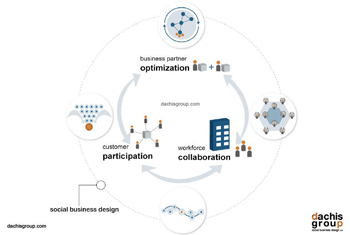
The concept of a learnscape, initially outlined by Jay Cross, focuses our attention on designing ecosystems to heighten the innovation and performance of people. I lay out some thoughts about learnscapes and shaping ecosystems below, using key concepts from the Dachis Group’s framework, initially discussed in an earlier post on HP’s WaterCooler project. I don’t claim these insights provide proven techniques for shaping enterprise ecosystems. But, I do think they point in a useful direction for those thinking about Enterprise 2.0 and social media strategy to keep in mind. Read the rest of this entry »
You are currently browsing the archives for the Social Business Design category.
Skilful Minds discusses Experience Design
and the ways it matters to client stakeholders, whether users, consumers, customers, learners, or just plain people.


 Posted by Larry Irons




 What do you think the typical manager might say if you told them their employees don’t gossip and engage one another enough in social interaction at work?







 Even though I was almost in the store when I saw it,

 Harold Jarche recently offered
 The emergence of social media provides people inside and outside organizations with a way to actively


