Online Brand Conversations and the Engagement Gap

January 27, 2009
box

We Need A New Box

A recent report from the Chief Marketing Officer Council provides an interesting set of insights into the engagement gap. The engagement gap refers to the difference between the influence of the Internet in consumer decision making and the amount of spending, and effort, by corporations and government agencies in trying to interact with and shape the thinking behind those decisions.

The CMO Council report summarizes the overall results of the survey as follows:

What we are seeing is much stronger sensitivity to engage directly with customers and learn more about what shapes, influences and impacts purchasing decisions and intentions to do business. The move to quantify “customer affinity” and increase “customer advocacy” has become a new measure of marketing effectiveness…

Read the rest of this entry »


Open Innovation at Procter & Gamble’s Social Media Lab?

January 27, 2009
p_g_social_media_lab_small

P&G Social Media Lab

As part of an overall critique of self-oriented approaches to innovation, Skilful Minds first considered open innovation at Procter and Gamble back in 2006. The latter post is one of the most visited here.

Given my recent focus on transformation as a fundamental concern for those interested in design and innovation, the recent publicity about P&G’s Social Media Lab instantly drew me to take a look.

Read the rest of this entry »


Twitter Friends and the Influence of Influentials in Word of Mouth Marketing

January 16, 2009
hp-0

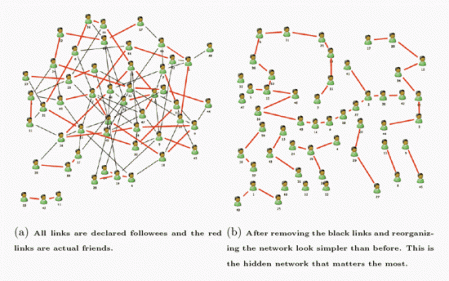
Social Networks that Matter

Without going into links to specific posts, I’ve noticed a trend among many blogs I try to keep up with over the past couple of years. I can’t count the number of times I’ve seen prominent bloggers post publicly about having to pare down the list of RSS feeds they read, or tweets they respond to. Since Peter Kim’s blog is the most recent instance of the trend I’ll use one of his recent posts as an example of what I mean. Peter noted that he increasingly hears an echo chamber across social media blogs in which the same content, case studies, anecdotes, etc. gets repeatedly posted and commented on. More cynical observers might contend that the complaints about information overload from influentials is a little like strutting in front of a crowd. Nevertheless, it is difficult to dispute the point that attention is a scarce resource on the Web. So is engagement.

Ross Mayfield recently pointed to a study published by researchers at the Social Computing Lab of HP Laboratories that addresses the point succinctly by pointing to constraints on friendship in directed social networks such as Twitter. A directed social network is characterized by an absence of explicit reciprocity constraints, fifty people can follow one person without that person necessarily following any of them. First Monday’s most recent issue includes an article, Social Networks that Matter: Twitter under a Microscope, that reports on a study of Twitter users by Bernardo A. Huberman, Daniel M. Romero, and Fang Wu of HP Laboratories.

The authors analyzed data from 309,740 people using Twitter. They compared the network of interactions people actually engage in while using social computing technologies such as Twitter to the network of connections with whom one shares a social relationship. Networks of actual interaction are considered networks that matter by the authors.

By networks that matter we mean those networks that are made out of the pattern of interactions that people have with their friends or acquaintances, rather than constructed from a list of all the contacts they may decide to declare.

In other words, the research focused on reciprocity as well as connection in studying the social network of Twitter. 
Read the rest of this entry »


Transformation as a Deep Metaphor for Design

January 7, 2009

Bruce Nussbaum recently declared Innovation is Dead, initiating a lively discussion around the issue of whether one term for change is better than another.

Before listing out Bruce’s key points, it is important to recognize that he isn’t saying that innovation is unimportant. Rather, he is pointing to the necessity of approaching meaningful change as a transformation of relationships between people and institutions, not just innovation at the edges through altering the systems allowing us to manage products and services.

Following his initial post, Bruce summarized his thinking in succinct form.

1- Our institutions aren’t working. They are broken. Corporations, investment banks, health care, schools, universities, Congress, transportation. The current crisis is accelerating the breakdown in the major institutions of our lives that began in the 90s.

2- Digital technology is disintermediating every organization, eroding the role of all middle men and women, from ad agencies to college professors, from newspaper editors to hospital administrators, from political parties to savings banks. The shape of all our institutions is radically changing.

3- The power to create and participate is moving to the masses. Digital technology is giving everyone the tools to tinker again, to design and shape their learning, their working, their play. Craft is back in newly significant ways that we are just beginning to understand.

4- “Innovation” is inadequate as a concept to deal with these changes. You have “game-changing” innovation, which is big but rare and incremental innovation which is small but common. “Innovation” implies changing what is. “Transformation” implies creating what’s new. That’s what we need today, a huge amount of totally “new.”

5- Design is the answer. I use the term “transformation” to capture the immensity of the task ahead of us and to guide us in the magnitude of that task, but the actual tools, methodologies and, yes, philosophy of that mission is found within the space of design and design thinking.

Read the rest of this entry »