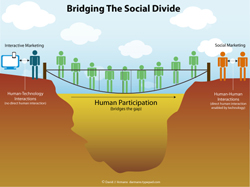
 David Armano recently made a distinction between interactive advertising and social media which he depicts in the image on the left. He noted that many companies mistake interactive advertising with social media and notes that the two differ in the place of PEOPLE in the strategy. Specifically, David points out that interactive advertising involves Human-Technology Interactions. Whereas, social media involves Human-Human Interactions enabled by technology.
Bringing Personas to Life in Social Media Marketing
October 22, 2008
 6 Comments |
  Brands, Community 2.0, Experience Design, Social Media, Web 2.0 | Tagged: community, interactive advertising, Persona, social media marketing |
  Permalink
 Posted by Larry Irons
Web 2.0, Digital Signage, and Ubiquitous Computing
October 20, 2008
The image on the left was used by Paul Dunay over at Marketing 2.0 in a recent post on digital signage. Paul notes that a recent Razorfish survey ranked digital signage (32 percent) as only second to mobile (51 percent) in importance as an emerging media channel. He also takes note of examples of new media channels that combine the two, mobile and digital signage.
2 Comments | Social Media, Ubiquitous Computing, Web 2.0 | Tagged: digital signage, Social Media, Ubiquitous Computing, Web 2.0 | Permalink
Posted by Larry Irons
Experience Design using Bone Conduction
October 16, 2008 Skilful Minds reminded readers about place-based story experiences like [murmur] recently after I visited the Missouri Botanical Gardens (MoBot) to see the Niki exhibit. The Niki exhibit showed forty mosaic sculptures done by Niki de Saint Phalle (1930 – 2002). Each concept used cell phones to either allow visitors to places to share stories about the place, as in [murmur], or allow visitors to listen to stories about specific exhibit items, as in the Niki exhibit.
Yanko Design showcased a design recently called touched echo developed by Markus Kison. Touched echo makes a place-based story experience available to visitors without the use of devices like cell phones. Although the technology was anticipated in an early experiment by Laurie Anderson called the Handphone Table, applying it to place-based stories is a new and innovative experience design. The design works by using bone conduction for hearing rather than transmitting audio waves through the air.
Leave a Comment » | Cool Entries, Experience Design, Innovation, Social Media | Tagged: bone conduction, exhibit, Experience Design, Innovation, Social Media | Permalink
Posted by Larry Irons
Visual Tags at DevLearn08
October 3, 2008 The eLearning industry is taking a step into visual tagging this fall with the eLearning Guild announcement that each attendee at DevLearn08 will receive a personalized QR code containing their contact information. As we noted in earlier posts,
Visual tagging is useful in creating social networks around products and events [such as DevLearn08], augmenting people’s experience with places, mobile learning, and transacting eCommerce at websites, among other potential uses.
DevLearn08 plans to use QR codes for its v-Tags. Take a look at the video tutorials on how DevLearn08 plans to use v-Tags.
Share this post…
 :
:  :
:  :
:  :
:  :
:  :
:  :
:  :
:  :
:  :
: 
Leave a Comment » | e-Learning 2.0, Learning Experience, Social Media, v-Tags, Web 2.0 | Tagged: 2d codes, devlearn08, e-Learning 2.0, mlearning, QR codes, v-Tags, visual tags, Web 2.0 | Permalink
Posted by Larry Irons
Stop with the Rollin’, Rollin’, Rollin’: Customers aren’t Targets for Social Media
October 1, 2008 Keeping up with social media is a real challenge these days. However, one theme seems constant whenever you read blogs about social media, especially among marketers and so-called optimizers who target, target, target to drive, drive, drive customers to their client’s social media asset, i.e. video, blog, community, etc. You would think advocates of social media are Rowdy, Gil, Jed, or one of the other actors on Rawhide.
1 Comment | Brands, Customer Experience, Experience Design, Social Media, User Experience, Web 2.0 | Tagged: customer engagement, Experience Design, SEO, Social Media, social media optimization, targeting, Web 2.0 | Permalink
Posted by Larry Irons


 Skilful Minds