From "A Journey Round My Skull's" photostream on Flickr
Recent studies, one by Sentiment360 and the other by FreshMinds, concluded that social media monitoring tools aren’t very accurate in automatically measuring sentiment, much less influence. The insight isn’t a new one and speaks to the now well-known issue of whether social media engagement is scalable. Consequently, we now see social media monitoring companies combining with text analytics companies to bundle their service offerings to increase their ability to monitor a customer’s activity and online influence, tracking that information to the workflows of marketing, sales, customer support, or operations in near real-time.
How well hybrid analytics companies, combining social media monitoring with text analytics, can deliver on the automation promise, and scalability, in managing the customer experience remains in question. For example, in attempting to convey the limits of the marketing promise, Maria Ogneva of Attensity360 in The “Right” Degree of Automation recently offered the following distinctions, between process automation, response automation, and pre-response automation.
Process automation involves developing rules to use in decisions about the flow of information. Response automation involves using automated and “canned” responses to customer questions, generally a “no no” in social media unless tied to an information update rather than a marketing message. It is worth noting, as Maria’s colleague Michelle de Haaff does, that response automation also includes automatically determining which social media messages merit engagement and which ones don’t. The whole SCRM discussion needs independent research on these new hybrid tool sets to assess their degree of accuracy over the existing automated sentiment analysis tools.
I don’t think it is too soon though to assert, following Mark Tamis recent point, that the importance of collaboration across the Enterprise and its ecosystem is crucial to SCRM. It isn’t as simple as training people to collaborate, as some imply. Rather, a learning organization and the culture that goes with it are crucial preconditions for employing analytics effectively in SCRM, especially if business processes and work practices are to deliver customer experiences seamlessly.
The thoughts Maria shared about pre-response automationare key to our discussion here.
Somewhere in between process and response automation there exists another kind of automation. It’s a hybrid of sorts, let’s call it pre-response automation. What in the world is pre-response automation? Well, I did just make up the term, but bear with me – let’s see if we can make it catch on. Your system reads, understands and distributes social media messages in step 1. Then taking it a step further, it looks up a potential answer from either within your FAQ or an external user forum, and queues it up as a potential answer for the person who should be sending this message. This way, you as the company rep, get to send a message that’s automated and personalized at the same time. The thing you are automating is the research that would take you time to look up – time you would’ve spent on a menial task that could be spent on engaging and humanizing your responses. Imagine how many more customers you could talk to then! As long as you are putting human touches on all of your messages, using automation to help you write the straightforward response is A-OK. Of course this only works for fairly straightforward cases, nothing custom or complex. Then there’s no shortcut around research (my emphasis).
Maria’s distinctions about how to apply text analytics in fine tuning social media monitoring to engage the customer experience are well put. In fact, as Lior Arussy recently noted, the more Social CRM advocates promise automation as a feasible choice for meeting the scalability challenge of social media for businesses, the more their consulting strategy mimics traditional IT consulting where the technology, though claiming to only provide a part of the solution, is actually assumed by clients to provide THE solution. As a result, crucial organizational and cultural challenges too often go unaddressed.
…we should not rush to embrace new technologies, when we lack the substance to initiate the customer engagement. A fan club on facebook or constant tweeting will not disguise inferior customer experiences. In fact it will only magnify the problem and distribute it to millions of potential new customers.
At the core of social CRM success must be not the tools but the organizational readiness to act. Both through executives’ readiness to listen and commitment to act combined with design and delivery of superior, differentiating experiences.
In his comment to Lior’s post, Marc Mandel observed that ” in my experience the fault about trying to substitute a tool for a truly appropriate organizational solution is neither the exclusive domain of the buyer or the seller, but often a shared culpability.” To her credit, Maria Ogneva of Attensity360 straightforwardly notes that analytics and monitoring tools cannot substitute for a business strategy.
How can we keep the people and culture challenges in organizational focus while deploying analytics in SCRM? As Christian Finn, Microsoft’s Director for Collaboration and Enterprise Social Computing, recently noted regarding Microsoft’s use of Sharepoint 2010, “Solve a Problem, Don’t Deploy a Technology”. To get more specific, ready the organization to solve bumps in the customer experience in a seamless way first.A good customer experience can be delivered without SCRM technology, as the video below by Jaffe Juice makes clear in relationship to an experience with Starbucks and Foursquare.
Frequently a seamless customer experience will needdelivering without SCRMsince the customer’s job demands application of a barely repeatable process.Or, as Sig characterizes barely repeatable processes over at Thingamy,” The activities that employees spend most of their time on every day”.
Over the past five years my thinking and work focus is on the strategic importance of dialogue between businesses and customers. The potential of social software, specifically social media and also Social CRM, to extend dialogic opportunities between the wants and needs of customers and the way companies meet those wants and needs with products and services intrigued me from the start. On several occasions I’ve discussed dialogue in relationship to organizational self-orientation, open innovation, brand strategy, and learning.
As I recently noted,
A dialogue strategy builds on the assumption that companies learn more from customers when customers learn from them, and doing so benefits both. I increasingly think it provides a basic framework to think about, and consider as part of your experience design strategy, when relating to customers. Thought leaders increasingly refer to the challenge as social business design.
The overall premise of this way of thinking rests on the idea that consumers and customers, as well as others with influence in a company’s ecosystem, are gaining increasing power to affect the meaning and value of brand offerings as well as the evaluation of operating assumptions. As a result, strategic efforts of organizational transformation are inevitable for most companies. Dave Evans puts it well,
Social CRM involves multiple elements, linked together, to provide an end-to-end understanding of how your brand, product, or service is received in the marketplace and how your internal processes produce and deliver experiences that drive this reception.
We’ve been talking to customers over the phone for how long? Exactly! So, what’s the difference? Sure, social platforms are more public. But, does the public nature of the channel automatically turn us into bumbling idiots that are going to trash our company’s brands in 140 characters?
Barry seems to make the point that you don’t need to know how much influence a customer exercises in your ecosystem to provide them with services. I certainly agree with him on that point, and I’ll offer a personal account about why later in this post. However, in my view, Barry draws the wrong conclusion from the point. He paraphrases a quote from Frank Eliason at a recent SOCAP conference when someone asked about influencers and influencer analysis. Frank, reportedly said, ” I’m in customer service. I don’t care how influential they are. I need to solve their problem. Do you ask who your customer knows before you answer their question on the phone?”
I suggest that the influence of the customer does matter for the business supported, but not necessarily for delivering customer service alone. Along the same lines, Paul Greenberg notes in his consideration of the concept of Social Relationship Management developed by Brian Solis,
Measuring the whispers gives you some idea of how influential someone can be or how fast a trend can grow or what kind of chatter is spreading about your company — good or bad — and who is spreading it….
…Optimally, using these measures will help you gain some insight into individual customers and their particular influence. If you then provide them with the personalized products, services, experiences and tools they need to sculpt their own relationship with you, because the customer is prone to trusting “someone like me”, it is entirely possible that they will think of your business as a “company like me.”
Influentials matter, especially if they are one of your customers, or even a brand advocate, since they can help you flip the marketing funnel through word of mouth. These opportunities do not reduce to the goals of Public Relations, or marketing, or sales, or operations, or any other specific functional area of a business. The interrelationships are too important for specific functional areas to adopt tailored solutions to their own processes and add the word Social as an adjective, as Mitch Lieberman’s comment on Barry’s post makes clear.
Any strategy needs to support cross-functional goals and objectives which, I think, makes it essential to create or take advantage of new dialogic opportunities, or existing ones, in the business ecosystem. Not doing so, or simply approaching Social CRM as a solution, threatens to fail in an analogous manner as CRM itself did, treating relationships as transactions. Perhaps a cautionary tale about CRM can convey the point. I offer the following anecdote of my own recent experience as a customer of a technology service provider’s CRM system. Note that my experience was a social one, even though the business, XO Communications, doesn’t seem to recognize that social channels exist, nor does it seem capable at managing communication across channels with customers.
My last post dealt with transformations in the grocery shopper’s service journey in the United States since the late 19th century, after creation of the shopping bag. It noted that, before the shopping cart was introduced into grocery stores, the shopper’s journey started with paper grocery bags and noted the transformation required to get shoppers to use shopping carts.
In recent years, local and state governments, grocers and other retailers, as well as many shoppers increasingly understand the environmental impact of using so many disposable bags, whether paper or plastic. Not to mention the direct costs to the grocer in providing the disposable bags.
Paper bags cost four cents each on average and plastic bags one cent. The cost per year in the United States is over four billion dollars, leaving aside all the unintended harm to the environment. This post suggests that shoppers exhibit a purposive desire to use reusable shopping bags. When will the large grocery chains design the customer journey to reinforce the purposive desire of their shoppers? Customers expressing such a purposive desire need symbolic resources to aid them in remembering to take their reusable shopping bags,
from here
or here
to here
and, finally, here
Let’s start off with an anecdote.
Schnucks is a grocery chain in the St. Louis area that I sometimes frequent. The particular store I shop in seems to stock the best Bibb lettuce in my area and that is the main reason I go there. Earlier this year, as I entered that store, I experienced the simplest solution you could imagine to a recurrent problem many retail shoppers face.
Someone in this store took the time to mount a reusable Schnucks bag onto a matte board and attach it to the Enter doorway. Even though I was almost in the store when I saw it, the mere sign with no call to action gave me the motivation to turn around and go to my car trunk to retrieve some reusable bags.
My household owns 15 – 20 reusable grocery bags from various retail chains in St. Louis, Schnucks and Dierbergs. I keep several of those reusable bags in the trunk of my car to use whenever I go shopping, especially for groceries. I’m sure many of you do the same with stores in your area. Needless to say though, I can’t count the times I’ve reached the checkout counter and realized that the answer to the “paper or plastic” question is, “Oh crap, I forgot to bring my bags in with me.”
For those of you who own reusable shopping bags I’d wager you know the experience. In fact, one of the reasons my household has so many of these reusable bags is that my wife often forgets also, but she is not reluctant to just buy another one or two bags instead of using paper or plastic. Don’t ask!
In addition to an inexplicable sense of inappropriateness, which my wife says she shares, in bringing a Dierbergs bag into Schnucks, and vice versa, or banish the thought, to bring a Schnucks or Dierbergs reusable bag into Whole Foods or Trader Joes, the main culprit for my failure to remember is usually just getting in a hurry.
Consider the following numbers:
40% of 1,000 people surveyed by Consumer Reports in the United States say they own reusable shopping bags and use them along with grocery supplied plastic and paper bags
17% of 104,830 people surveyed by MSNBC in the United States say they consistently use reusable shopping bags
Any way you look at the numbers, many more people own reusable bags than use them consistently. Someone at the Schnucks store who posted the sign is obviously listening to those customers who end up at the checkout and express dismay over forgetting their reusable bags. None of the other five or six Schnucks stores I occasionally shop have posted such signs. Schnucks lacks a strategic communications strategy for addressing the green customer need in question, i.e. the desire to remember reusable bags.
Schnucks isn’t alone. Dierbergs doesn’t provide signs to support reusable bag shopping at the start of the customer journey. Neither does Whole Foods or Trader Joes, at least in St. Louis. Nevertheless, the Schnucks store discussed in this post developed a workaround for the overall failure of the company to engage the shopping journey needs of its customers. It serves as a paradigmatic example of service design brought to the wayfinding challenges of grocery shoppers who are interested and motivated to minimize their environmental impact.
A customer that voluntarily expresses dismay over leaving their reusable shopping bags in their automobile trunk, or at home, is also revealing a desire, an emotional response to their own failure to remember a personal commitment to a larger purpose, i.e. they want to act in an environmentally responsible way. It is a purposive desire. I suggest that such purposive desires are relevant to service design and wayfinding, and the sections below outline how.
Grocery shopping is one of those chores that we all have to do from time to time. I’m introducing the topic of grocery shopping as a service journey not because the concept is new. In-store ethnographic studies, and shop-alongs, implicitly recognize the concept. Few people who analyze what grocers do, and how people who shop in their stores get the job of buying groceries done, would be surprised that it is a journey. And, of course, the journey starts in the shopper’s home, which Tesco’s Fresh and Easy discovered the hard way when they expanded from the United Kingdom to the United States. What I want to do here is provide a brief, high level history of the U.S. grocery shopper’s journey, and key transformations of that journey, to establish the context for my next post.
Other than time, money, and typically transportation, two pieces of technology are critical to the journey we take as we shop, especially for groceries. We must collect items around the store and move them to the checkout counter. Once our grocery items are checked out and we pay for them, we must move those groceries from the store to our source of transportation. For many of us that transportation consists of an automobile, or other vehicle; for others it may be public transport.
A partial solution to the challenge of collecting items around the store came with the invention of flat-bottomed paper bags by Margaret Knight in 1870. However, it really wasn’t until Walter H. Deubner, a grocery store owner in St. Paul, Minnesota, created a shopping bag in 1915 (a paper bag with a cord running through it for strength) that a workable solution to the challenge of collecting and moving items from shelves to the checkout counter came along. The Deubner Shopping Bag carried up to seventy pounds of groceries. In other words, at least initially, the grocery bag was supplied before customers began to shop.
The invention of the shopping cart by Sylvan Goldman in 1936 provided the basis for changing the shopping journey. Consider the problems he faced in persuading shoppers to change their shopping journey.
Goldman’s concept was simple: make shopping easier for the customer and they’ll visit the store more frequently, and buy more. Unfortunately, the customers didn’t want to use the carts. Young men thought they would appear weak; young women felt the carts were unfashionable; and older people didn’t want to appear helpless. So, Goldman hired models of all ages and both sexes to push the things around the store, pretending they were shopping. That, and an attractive store greeter encouraging use of the carts, did the trick.
Paid female model pushing shopping cart.
By 1940 shopping carts had found so firm a place in American life as to grace the cover of the Saturday Evening Post. Supermarkets were redesigned to accommodate them. Checkout counter design and the layout of aisles changed.
As a result, shopping bags were relocated in the shopper’s journey, with the exception of small bags for produce and other perishables. The invention of plastic bags later on added another alternative for bagging, in the produce section as well as the checkout counter, and it was a cheaper direct cost than paper.
Today, the result of these basic technologies for supporting grocery shoppers makes the experience much easier, no doubt less stressful on the back and shoulders than carrying heavy bags around the store while shopping. My next post focuses on the current transformational challenge facing the grocery shopper’s service journey through the diffusion of reusable bags.
Marketing, especially social media marketing, and learning, including organizational learning, are both essential components of a dialogue strategy for customer experience design and management. A dialogue strategy builds on the assumption that companies learn more from customers when customers learn from them, and doing so benefits both. I increasingly think it provides a basic framework to think about, and consider as part of your experience design strategy, when relating to customers. Thought leaders increasingly refer to the challenge as social business design.
Given the maturity and diffusion of social media, a dialogue strategy provides a framework to discuss communication as an ecosystem, whether addressing collaboration, innovation, segmentation, sales, customer service, or brands. The key to the process is understandingcustomers, attractingthem, engagingthem with sales in mind, empowering them to solve your product and service problems, and learningfrom them to improve products and services, thereby strengthening your brand. It is not simply segmenting them, targeting them, driving them through interactions, and transacting with them through sales.
Over time, people buy things they need from you rather than someone else because they want what you offer, and because they feel an empathic connection, i.e. that you understand them. From my reading, Wim Rampen’s contention that we need to use segmentation the customer’s way gets to the heart of the point. The challenge of learning how to make an empathic connection increases to the extent that CRM (customer relationship management) aims to align customer engagement directly with business transactions.
Those looking for a direct, sustained connection between customer engagement and sales from Social CRM are expecting too much in my opinion. The key question is whether you know that Jane Smith who called for support tonight also chatted with one of your people earlier, or posted (or tweeted) something positive or negative about you on her blog, or posted something about your product/service to a how-to community forum. Knowing any of those things about Jane’s activities and experiences with your brand increases the potential for empathic connection between your people and Jane, meaning your understanding of what Jane needs from your products/services increases.
It would be nice if a monitoring platform could listen for you and, just automatically, determine how influential Jane Smith really is in the scheme of things. It might be nice to have a social media management system that just took care of everything, gauged the influence of anyone commenting about you online, ranked their value relative to your brand, and prioritized the level of response needed. However, in the near term, regardless of how much we want that panacea, your employees, or outsource partners, are going to need to engage with your customers as though their problems are your own.
Nestle’ can speak to that issue recently. It is important to note that the Nestle’ example is not the first time a company’s supply chain management, rather than a product or service per se, came under organized criticism. Nike and Shell, among others, found their own supply chain relationships under fire over the past decade. Indeed, Shell’s early experiment in 1998 with a blog called Tell Shell came under such negative commentary from the public that the company shut it down. Nike, on the other hand, engaged the debate and incorporated the criticisms into its business model, I’ll leave it to you to decide which brand strategy makes the most sense for customer relationships.
Harold Jarche recently offered a framework for social learning in the enterprise in which he draws from a range of colleagues (Jay Cross, Jane Hart, George Siemens, Charles Jennings, and Jon Husband, all members of the Internet Time Alliance) to outline how the concept of social learning relates to the large-scale changes facing organizations as they struggle to manage how people share and use knowledge.
Harold’s overall framework comes down to the following insight,
Individual learning in organizations is basically irrelevant because work is almost never done by one person. All organizational value is created by teams and networks. Furthermore, learning may be generated in teams but even this type of knowledge comes and goes. Learning really spreads through social networks. Social networks are the primary conduit for effective organizational performance…Social learning is how groups work and share knowledge to become better practitioners. Organizations should focus on enabling practitioners to produce results by supporting learning through social networks.
Indeed, Jay Cross suggests that the whole discussion needs framing in terms of collaboration, and I tend to agree. Yet, saying social learning occurs largely through collaboration means delving into the subtleties of how social networks relate to the organizing work of project teams as well as to their performance. After all, much of the work done in Enterprises involves multidisciplinary teams, often spread across departments, operating units, and locations.
One of my earlier posts posed the question Who’s on Your Team? to highlight the importance of social networking to establishing team identity and enhancing knowledge sharing across distributed, multidisciplinary teams. Its focus was on the importance of social software applications in the Enterprise to the ability of distributed project team members to recognize who is on their team at any point in time, and who isn’t. Organizational analysts refer to the challenge of establishing team identity as a boundary definition problem for teams, when members are spread across large distances whether geographic or cultural in nature.
As I noted in a post on Peter Morville’s Findability several years ago,
“Interfaces are not what they used to be. The computer-human interface is both more and less than it was a few years ago. Interfaces are not only, or even primarily, a screen anymore. Yet, screens remain important to most design efforts, even though interfaces are increasingly part of the environment itself. As John Thackara and Malcolm McCullough both recently pointed out, entire cities are developing into user interfaces as ubiquitous computing environments expand.”
Caleb, over at MobileBehavior, recently observed that mobile phones do not yet provide users with a graphic language for touch interactions. Caleb’s post points to an early visualization of a standard graphic language offered by Timo Arnall of the Touch project, which researches near field communication. Caleb makes his point by talking about the confusion that consumers experience when faced with a visual tag (v-Tag), or 2D Barcode, and does so with the following Weather Channel forecast that offers viewers an opportunity to interact with a visual tag using their mobile phones (wait until about 45 seconds into the video). The forecast fails to indicate to viewers what the v-tag does.
The user experience team that developed the v-tag for that particular forecast must have assumed viewers would know it represented an invitation to interact. A search on the Weather Channel website fails to return any information on the use of v-tags in their media programming though.
In a previous discussion of Dan Saffer’s book, Designing Gestural Interfaces, I made a similar point about mundane gestural interfaces in public bathrooms, a setting with fairly established graphic language conventions. Yet, even such mundane gestural interfaces can pose difficulty for users. As I noted,
I remember the first time, a few years ago, when I tried to get water flowing through a faucet in a public restroom that used sensor detection. Initially, it was not obvious to me how the faucet worked, and I suspect others continue to experience the same problem based on the photo I took during a recent visit to a physician’s office.
Among other observations, it is important here to note that these examples provide clear instruction for why experience design encompasses user experience. Specifically, people only experience a user interaction if the interactive capability of an artifact is intelligible, if they recognize the artifact as an instance of that kind of thing, i.e. an invitation to interact with media or machinery. Who knows how many people noticed the Adidas logo embedded in a v-Tag on their running shorts, or shoes, and failed to see it as an invitation to a user experience?
People can’t use an interface if it is not recognizable as such or, as the Palcom team coined it, palpable to their use. Otherwise, the invitation to experience, what Dan Saffer calls the attraction affordance, fails. Consider the more telling example of the symbol at the top of this post. It represents an RFID signal environment for devices using the Near Field Communication (NFC) standard. Indeed, Timo Arnall and Jack Schulze’s recent work for the Touch project demonstrates the spatial qualities of an RFID device’s signal, the shape of its readable volume.
Dan Saffer, in Designing Gestural Interfaces, touches on the fact that we are currently missing common symbols for indicating when an interactive system “is present in a space when it would otherwise be invisible,” or when we just wouldn’t recognize it as such. Adam Greenfield’s Everyware made a similar point a half decade ago.
Ethnographers are traditionally known for immersing themselves in the everyday lives of people and paying attention to the details and context of their activity. Anthropologists after Malinowski considered extended participant observation in the lives of the people they studied a prerequisite for analyzing culture. However, in the last few decades of the twentieth-century ethnographers began to consider their analysis increasingly as a challenge of interpreting cultural phenomena rather than explaining their variation.
With the increasing availability of the Web, researchers using computer-mediated communication, i.e. digital, devices in their projects label their work under a range of categories. I’ve discussed ethnography several times before, the first taking note of the trend toward virtual anthropology and the next talking about the significance of Tom Boellstorff’s ethnography of Second Life, followed by a couple of posts about ethnography’s relationship to empathyand globalization.
In 2003, Cheskin’s Davis Masten and Tim Plowman characterized digital ethnography as the next wave in understanding the consumer experiencein Design Management Journal. To my way of thinking they were correct in asserting that, “Digital Ethno enables participants to convey the real-time richness of their own lives and environments.”
Along with any new wave in understanding people’s experience comes a range of neologisms intended to clarify the multiplicity of research options that emerge. Kozinets recently suggested that the use of ethnography in computer-mediated research activities is best described as Netnography, a neologism he dates from 1996. He argues for the use of the term, netnography, in the following way:
Netgography differs from other qualitative Internet research techniques in that it offers, under the rubric of a single term, a rigorous set of guidelines for the conduct of computer-mediated ethnography and also, importantly, its integration with other forms of cultural research (p. 15)
However, as Kozinets suggests, the 2008 survey of Intenet users done by the Annenburg Digital Futures Project found that 56% of the members of online community members meet other members of their online community face-to-face. And, as Kozinets further notes, the Annenburg research did not include social networking sites, making the figures conservative ones since, as Brian Solis recently noted, social networking combined with geo-location and augmented reality applications is bridging the online and offline interaction. Kozinets insists that this simply means research must blend ethnography and netnography to study the intermixof online and offline activity.
I won’t go into all the reasons I think Kozinets thinking on the relation between netnography and ethnography fails to persuade. Suffice it to say that, to my mind, as Web 2.0 increasingly permeates peoples’ everyday lives, the term netnography fails to sufficiently describe the way ethnography works in a consumer environment where digital devices are ubiquitous.
As people increasingly access the Web and engage online communities on the go, the notion that this is happening on the net seems quaint. If any term is needed other than ethnography, I’d suggest digital ethnography remains the most fitting. When we consider mobility as part of a ubiquitous computing environment, defining the relationship between spaceand placeincreasingly requires analyzing social practices rather than simply distinguishing a time and location for an activity.
As Johanna Brewer and Paul Dourish observe, “space is not simply an ‘inert container’ for the places of everyday experience; rather, space itself is the outcome of particular ways of reasoning about and representing the world.” Brewer and Dourish note, for example, that research on mobile messaging used to coordinate meet-ups or other rendezvous allow for people to show-up using a proxy form of participation before they get to the physical meeting. Additionally, the recent research by Hope Jensen Schau, Albert M. Muniz, Jr., and Eric J. Arnould, How Brand Community Practices Create Value from the Journal of Marketingexplicitly approaches brand communitiesusing a range of qualitative techniques, including netnographic, to study participants across several years both online and off.
My inclination regarding ethnographic methods is to endorse the point of view offered in Sunderland and Denny’s Doing Anthropology in Consumer Research. They note,
…ethnography is not a method per se, but rather a collection of methods…In commercial consumer research circles, one sometimes hears various rules, on the order “it is only ethnography if there is observation,” or “video,” or “multiple meetings,” or “sufficient time,”…or…(filled in with any number of favorite and idiosyncratic rules. But what seems most accurate about ethnography as a companion mode of discovery in cultural analysis is that as a methodology it must be viewed through, and seen as permeated with, the sociocultural. (p. 50, my emphasis)
In other words, the specifics of the methodology matter less than its purposive application. Following Geertz, Sunderland and Denny contend, the methodologies employed, whether participant observation, focus groups, in-depth interviews, diaries (online or offline), village censuses, surveys, or maps, “are not ‘ethnographic’ per se, but…are made so by the intellectual framing of the task” (p.52).
The purpose of ethnographic research is as important as the methods used, as long as the sociocultural context remains in focus. For example, whether we use ethnography in marketingor designresearchremains irrelevant to the methods employed. What matters is whether we develop the research questions around the assumption that sociocultural practicesprovide the data source for answers.
One of the most visited posts on this blog is titled, Empathic Research Methods and Design Strategy. Indeed, if you google or bing “empathic research”, the post pops to the top few links, or vey close, often even ahead of IDEO. My aim in that post was to add to points made by Adam Silver, a Strategist at Frog Design, noting that globalization and digitalization in the 1990s resulted in product and service interfaces with more culturally diverse and geographically distributed customers. The combination of these economic and social forces led designers to search for new methods to augment artistic intuition about form and function. Considerations of form and function also required attention to feel, emotions, features, and interactivity attuned to the needs, wants, and beliefs of users/customers. The power of ethnographic research to discern empathic insights by observing and interpreting people’s cultural activity is now widely recognized.
Recognizing the implications of globalization for design and marketing is certainly not new. The now classic book, The Design Dimension, by Christopher Lorenz, explained the crux of the point as early as 1986. Lorenz noted that,
…globalization does not mean the end of market segments, but their explosion to worldwide proportions. Far from declining, the number of market segments may actually increase…Though industrial designers frequently can – and do – substitute for the absence of marketing imagination. In most companies the most potent force for imaginative marketing and product strategy is a real partnership between marketing and design (pp. 146-147).
The significance of Lorenz’ point came back to me recently while reading “How does our language shape the way we think?“, by Lera Boroditsky, an Assistant Professor of Psychology, Neuroscience, and Symbolic Systems at Stanford University. Boroditsky’s research into language and thought complements a key point made in Malcolm Gladwell’s book Outliers, Gladwell informs us that one basic reason exists for the tendency of Chinese students to outperform others in math skills. Quite simply,
Take a look at the following list of numbers: 4,8,5,3,9,7,6. Read them out loud to yourself. Now look away, and spend twenty seconds memorizing that sequence before saying them out loud again.
If you speak English, you have about a 50 percent chance of remembering that sequence perfectly. If you’re Chinese, though, you’re almost certain to get it right every time. Why is that? Because as human beings we store digits for about two seconds at a time. We most easily memorize whatever we can say or read within that two second span. And Chinese speakers get that list of numbers—4,8,5,3,9,7,6—right almost every time because—unlike English speakers—since the Chinese language allows them to fit all those seven numbers into two seconds.
Whereas Gladwell’s interest is in the way language and culture affect our view of talent, Boroditsky is interested in whether, and how, language shapes the contours of thought itself, the kinds of questions people who speak a language are able to ask, and the kinds of significant symbols they recognize. Boroditsky’s research looks at an old question, and controversy, in anthropology and sociolinguistics — the Sapir-Whorf hypothesis.
While meeting for drinks and food at Llywelyn’s Pub a few weeks ago on a Sunday evening with two of my oldest friends, one of them mentioned recently using Cisco’s Telepresence video conferencing. I was keen to learn about the experience. Rocky said the experience was really immersive and described in vivid detail the sense of sitting around an oval table with video feeding into displays that curve with the shape of the table to present participants at distant locations.
My first question was whether the configuration provided a reciprocity display to reflect back to each location how local participants are seen by others at different places. He said that it didn’t. I said it didn’t surprise me at all, given the name of the service — telepresence. It really is a pretentious name if you stop and think about it. After all, presence is roughly the sense one gets from being in an environment, and telepresence is the extent to which one feels present in a mediated environment, rather than in the immediate physical environment.
I consider myself an early adopter of communication tools that provide unique opportunities to engage other people. At the same time, I recognize the fact that face-to-face communication adds interpersonal depth, and not just bandwidth, to relationships that is either missing in asynchronous communication (whether user-generated or marketing -driven), or takes much longer to develop.
You know social networking is going mainstream when service companies like Roto-Rooter start using it. My sewer line backed up yesterday and I called Roto-Rooter to clean it. The guy came out like always, did the job, and I paid him. As he handed me the receipt he also gave me a flyer that asked me to go to either Google, Yahoo, Citysearch, or superpages.com and write a review of the service. Once a week Roto-Rooter selects a name from the reviews submitted on any of these search engines and refunds the cost of the service. It doesn’t say whether the selection process is random or related to the sentiment of the review.
I was a little surprised that such an old-world service like plumbing would encourage customers to review their work. I guess that impression comes from a recent review I wrote on Yelp about another plumbing companyin St. Louis. My review was far from flattering. Anyway, I thought Roto-Rooter’s engagement of social networking interesting enough to check out their activity. Sure enough, they have a blog that Paul Abrams, the Public Relations Manager, updates regularly, and Roto-Rooter maintains a presence on a range of social network channels. From their blog,
Courtesy of Wonderfully Complex’s photostream on flickr.
Word of mouth communities and networks using social software are increasingly spread over regional, national, and international borders, making them much more important to those who market branded products and services, online and off. The recent buzz around the concept of social business points to the growing importance of social networks and communities to the evolution of business practice. Whether companies are in fact closing the community gap or the engagement gap remains an open question though.
As Rachael Happe of the Community Roundtable notes in commentary on the Community Maturity Model:
in the stages before a company becomes truly networked, metrics are isolated to supporting one business process vs. in a networked business the whole business becomes social and the communities are set up to support cross-functional goals.
In other words, customer communities approaching maturity produce value for the business, or organizational enterprise, rather than only a specific functional area — such as research and development, product management, customer support, or marketing. Rachel’s overall point receives validation in a recent article in the September (2009) issue of the Journal of Marketingthat reports on long term ethnographic research on brand communities by Professors Hope Jensen Schau, Albert M. Muniz, Jr., and Eric J. Arnould, “How Brand Community Practices Create Value .” The most interesting thought in the article for me is their point that customer competencies are a valuable resource for building co-creation opportunities in brand communities.
Unlike earlier discussionsof customer competence, Schau, Muniz, and Arnould contend trying to co-opt customer competencies is the wrong strategy. Rather, their research findings suggest community management benefits from developing opportunities for customers to grow their competencies with the brand. They make it clear that their research indicates,
Companies wishing to encourage co-creation should foster a broad array of practices, not merely customization.” In other words, don’t try to keep the community focus only on what benefits the brand as you define it. The important point to keep in mind when discussing value in brand communities is that members create value for themselves through producing cultural capital distinguishing their status relative to the community, aside from the ROI and business value gained by the company owning the brand. Making sure members are provided opportunities to grow their competencies encourages them to reinvest their cultural capital in the brand community.
I discussed co-creation in several posts this past year in relation to eLearning 2.0 generally as well as Nokiaand, back in 2005, its overall importance to the challenge of creating successful innovation, including the relevance of customer communities to innovation outcomes. The concept of customer competencies captures the overall significance of co-creation for efforts to produce value through engaging customers. However, Schau, Muniz, and Arnould offer the additional insight that the competencies critical to brand communities are developed through community practices. By practicethey mean the linked, implicit way people understand, say, and do things. The term is further used to refer to the activities, performances, and representations (video, graphics, etc.) or talk of community members.
Experience designers can use the concept of customer competencies to inform choices about how to manage practices in customer communities. Read the rest of this entry »
I’ve known Steve Finikiotis over at Touchpointsfor some time, and especially appreciate his concept of the Validation Principle. I’ve seen the Validation Principle at work in my own experience managing online communities, as well as participating in many online communities. The key to any online experience is engagement, and engagement means relating empathically to other people in a way that they appreciate. Steve recently outlined the relevance of the Validation Principle to Twitteruse, and other social media, in a succinct way.
If you use Twitter or any of the other social networking tools, you’re bound to notice how much people crave acceptance and appreciation…Its obvious that people like being shown appreciation, but there’s more to being appreciated than meets the eye…When we’re validated by others, we’re inclined to bond with them. I call this the Validation Principle, and it’s one of the keys to building durable customer relationships.
The bond Steve is alluding to is a key part of any successful customer community. It contributes significantly to a community’s duration. Developing such bonds though is not an easy process, requiring time as well as attention. It involves learning from customers, and it involves their learning from your actions in relating to them.
Rule number one in managing customer communities is don’t fail to listen. Additionally, failing to recognize that customers know you are listening but feel like you just aren’t hearing them is equally damaging. Sometimes it is possible to listen effectively in an online community itself. Other times, you may need to actually do research to directly engage and validate passive members who mostly consume content (sometimes referred to as lurkers) to really understand the dynamics of an issue playing out in an online customer community.
What have you learned from engaging passive content consumers in customer communities?
My last post discussed the Open/Closed culture fallacyin social business design. I made the point that leaders of large corporations are typically unable to answer the key strategic questions posed by David Armano of the Dachis Group in a recent important post, Re-designing Your Business Culture. Among other questions, David asked:
Do we want real connections established between employees, customers, partners?
How can we reward those in our ecosystem who actively contribute?
Do we actually want to engage those who want to engage us? Can we?
As this post’s subject indicates, my interest here is to explain how social network analysis, applied to the ecosystems of organizations, helps apply social business design in a manner that avoids the fallacy of open/closed business cultures. We can’t know how open or closed a business culture is until we research, analyze, and understand both its formal and informal networks.
This post continues David’s line of thinking by considering a combination of two of his strategic questions in light of the open/closed culture fallacy. I also take a stab at noting how to answer his last question.
Think about a closed business culture. Try to visualize what it looks like. What do you see? Does it look something like a pyramid?
Now, think about an open business culture. Try to visualize it. What image comes to mind? Does it look something like a spider web turned on its side?
These two imaginings pose similar relationships between their parts. A three dimensional pyramid flattened out is about the same shape as a spider web. It is a matter of perspective as to whether one is more open or closed than the other. When connections are made across, rather than only between, the existing nodes in a network we can start to visualize informal relationships in a way that adds value to discussions of culture. It sounds simple, at least initially.
So, how do these observations relate to culture and social business design?
People who discuss the importance of social media, and actually social computing in general (Enterprise 2.0 included), continue to insist that the innovations involved will become as much a part of the tacit knowledge and expertise of ordinary people as email. I think that assessment is in fact correct. However, I want to add an insight that no one yet, to my knowledge, has offered.
Social media is not a noun (media) accompanied by an adjective (social). In fact, as long as we think of it that way social media can only fail to achieve what the thought leaders who advocate its use believe it capable of doing. Social media is, in fact, a compound noun, a noun made up of two or more words. Neither term is sufficient to describe what is done by those using it unless we consider it as part of the other.
I usually keep my discussions here focused on issues of experience design that cut across challenges faced by a range of professionals as they work to engage learners, customers, consumers, and just ordinary people. However, I saw something today that made me think about soil and the experience of working the soil. Just a little personal reflection I’d like to share.
I try to do a workout each day and today was no different. As I prepared for my 20 mile mental and physical excursion on my stationary bike, filling a large glass of water at the sink, my eyes were drawn to one of the guys who cuts our grass. He was on a large riding mower, stopped in the middle of my back yard, intently working with his thumbs on what looked like a smartphone from my viewpoint. Now I realize this is not a unique thing to see these days. Yet , it evoked a memory of mine that made me smile and take wonder in how an ordinary guy cutting a stranger’s lawn stays connected with anyone he needs to communicate.
I spent my youth in the late 1960s doing farm work in rural Alabama. One of my fondest, and most solitary, memories from that time involves driving tractors early in the morning. Farmers used to turn the soil each spring and then disc it into small clods before planting, a practice that since gave way to the better environmental practice of no-till farming. In the early spring, sometimes with frost still on the ground and a mist hanging in the air, I often found myself in a forty or fifty acre field alone on a tractor pulling a turning plow. Depending on how early it was in the spring, sometimes we tied cotton sacks along the side of the engine to bring back the heat for some warmth.
As the plow cut through the soil it turned the topsoil from about six to eight inches underneath onto the top of the ground. The crispness of the air and the earthy smell of the soil, provided a really pleasing experience, except for times when the wind shifted to blow the smell of the engine exhaust back in my face. The experience of such solitary work encouraged me to sing, which I enjoy doing to this day. Anyway, the image of the guy paused on the mower in my back yard texting someone to stay in touch made me wonder whether farmers still experience solitude when they are alone working a field with their machines.
My first corporate position carried the title Methods Analyst,working for a large billing center serving a telephone company.One of my main tasks in that role involved learning how other employees performed their work and documenting it. On each project I typically spent several hours observing people work (what some today call rapid ethnographyor guerilla ethnography) and then did in-depth interviews of the people I observed. Usually, at the end of my observation, I took responsibility for doing the work for a brief time under their watchful eye. In some sense you could say my work required me to continuously cross trainin other people’s work, analyze the process, and write it up in a technical document. The main insight I took away from that experience was an appreciation for the importance played by empathy in effective collaboration.
First off, collaboration isn’t just about people sharing information to achieve common goals. Collaboration is about people working with other people to achieve common goals and create value. Advocates of Enterprise 2.0 sometimes make the fundamental mistake of arguing that collaboration is really only about achieving business goals, leaving the implication that incorporating social software into the work flow of organizations is sufficient. Even though goal-orientation is a big part of collaborating, collaboration requires more to achieve goals effectively. It requires shared experience. As Dev Patnaik and Evan Rosen recently noted, empathy and collaboration go hand in hand.
The presentations from Transform are now available online. Take some time and listen to these videos if you are in the least interested in how to transform health care.
Health care is increasingly gaining attention as an area in which innovation involves informal learning, and many of the other topics that go along with using Web 2.0 to engage people. The current debates at the national level about changing health insurance carry with them an underlying focus on innovation in the design and delivery of healthcare services, an area referred to for several years as Health Care 2.0. And the Mayo Clinic is always at the top of the list when innovation is discussed in healthcare. So, it isn’t a surprise that the Mayo Clinic is sponsoring a symposium in September focusing specifically on innovating health care experience and delivery.
The symposium includes a number of segments with intriguing topics. However, the two I find most interesting are the Redefining Roles and the Content, Community, Commerce, Care, & Choices segments. It looks like a promising experience for those fortunate enough to attend.
Redefining Roles
This segment will introduce the emerging roles of disruptive technology and business model innovations in making products and services in health care affordable and accessible. It will touch upon the evolution of health care delivery systems — particularly hospitals — from geographically-centered and costly entities to decentralized and more focused operations. Participants will be introduced to emerging business models in health care, including facilitated networks — online communities of people who help to teach one another about how to live with their diseases. This segment will also explore the notion that health care can be designed to minimize the degree to which it disturbs peoples’ lives.
…
Content, Community, Commerce, Care, & Choices
Communities of people are sharing health care-related content online. This has come to be called “Health 2.0.” Individuals and organizations have built business ventures around sharing content. But what does it take for these models to evolve into reliable facilitators of wellness? How can these communities link with existing bricks-and-mortar care delivery systems in ways that help people in their journey to wellness? What are “microchoices” and how might they be more powerful than all of health care?
My interest in using communities to enhance the service experience goes back several years. I had not considered their application to health care services until recently when an associate pointed me to several hospitals using social media to connect with patients. It looks like a promising area for innovation and highlights the relevance of informal learning to health care services.
The emergence of social media provides people inside and outside organizations with a way to actively speak about, speak to, and engagethe product and service offerings of enterprises. Currently, 25% of search results for the World’s Top 20 largest brands are links to user-generated content and 34% of bloggers post opinions about products & brands. Enterprises, on the other hand, listen to, engage, and act on insights gained from social media.
A recent study of social media engagement by Ben Elowitz and Charlene Li covered the 100 largest brands and, among other conclusions, noted that,
One recurring theme throughout these case studies is that engagement cannot remain the sole province of a few social media experts, but instead must be embraced by the entire organization.
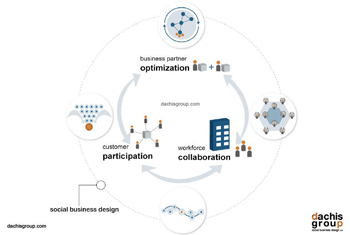
Channels, policies, processes, touch points and transactions are increasingly viewed as parts of the social experience organizations use to encourage employees in collaboration (also known as — Enterprise 2.0), and engage customers in conversation (also known as — social media) for the purposes of innovation and transformation of the business. The common goal of the ongoing discussion involves transforming business practices to incorporate social relationships into the value proposition to customers and other stakeholders.
Integrating engagement into enterprises is crucial to strategic efforts to use social software throughout an ecosystem, inside and outside the formal organizational hierarchy, as social business design. My contention is that such integration is most likely to succeed with a focused approach to informal learning. In my last post, Scalable Learning and Learnscapes in Social Business Design, I offered the following point.
The concept of learnscape is a useful framework for thinking about the strategic challenge to the range of learning activities occurring as companies attempt to create feedback loops between their brand experience and the functional areas of their enterprise, especially in regard to the multidisciplinary collaborationneeded to make these efforts successful.
The concept of a learnscape, initially outlined by Jay Cross, focuses our attention on designing ecosystems to heighten the innovation and performance of people. I lay out some thoughts about learnscapes and shaping ecosystems below, using key concepts from the Dachis Group’s framework, initially discussed in an earlier post on HP’s WaterCooler project. I don’t claim these insights provide proven techniques for shaping enterprise ecosystems. But, I do think they point in a useful direction for those thinking about Enterprise 2.0 and social media strategy to keep in mind. Read the rest of this entry »
Skilful Minds discusses Experience Design
and the ways it matters to client stakeholders, whether users, consumers, customers, learners, or just plain people.

 :
:  :
:  :
:  :
:  :
:  :
:  :
:  :
:  :
: 


 Posted by Larry Irons




 Even though I was almost in the store when I saw it,




 Harold Jarche recently offered








 The emergence of social media provides people inside and outside organizations with a way to actively


 Skilful Minds