eLearning 2.0, Social Media, and Co-Creation of Learning Content

December 29, 2008

openbook2As a previous post noted, assessing the business value of instructional design involves more than measuring the contribution of formal training to Level 3 and Level 4 outcomes defined in the Kirkpatrick model. Training professionals also need to understand and support informal learning processes, on-the-job and off, that enhance performance.  Most of the learning that produces business value occurs informally, dealing with exceptions to formal business processes, yet most of the attention paid to learning is focused on formal training.

One can reasonably say that Web 2.0 applications, such as social software and social media, are changing the relationships between instructional designers and subject matter experts much like those between customer communities and product designers. Both increasingly involve situations of co-creation.

The emerging recognition of eLearning 2.0’s importance to enhancing collaboration and performance means that training professionals, especially instructional designers, can add value to their employer/client’s business by learning to facilitate and manage the co-creation of learning content with employees, or even customers. Anyone experienced in instructional design in recent years is familiar with the general challenge of co-creation whenever they use information content for course design ( slide shows, documents, etc.) that subject matter experts originally created as a resource for a presentation. The presentation content too often is substituted for observation and in-depth interviewing as a first step in analysis. 

Such Rapid eLearning, though shifting content development toward the subject matter expert’s control, maintains the traditional role of training in incorporating design principles. The process of co-creation in eLearning 2.0, on the other hand, shifts control over development and distribution of learning content toward subject matter experts willing and able to share what they know, especially when they see other people who need to solve familiar problems.

Read the rest of this entry »


Informal Learning, Collaboration, and the Kirkpatrick Model

December 22, 2008
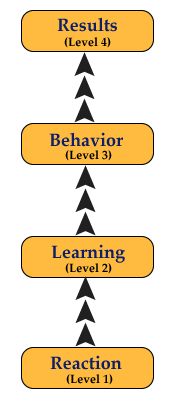
kirkpatrick1

Kirkpatrick Model

I recently attended a meeting of the St. Louis Chapter of the American Society for Training and Development (ASTD) to listen to a presentation on the Kirkpatrick model of training assessment, offered by Jim Kirkpatrick, the son of the model’s creator — Don Kirkpatrick. Jim’s major point was that most training departments fail to measure learning outcomes at Levels 3 and 4 of the model. Without detailing the Kirkpatrick model’s four levels of analysis, the following are Jim’s definitions:

Reaction: involves what training participants thought of the training

 Learning: the knowledge, skills, and attitudes gained through the training

Behavior: the degree participants apply what they learned on the job

Results: the business results gained

Suffice it to say that the model provides a unique framework on how to assess the  learning outcomes of training. However, practitioners are prone to overlook a key issue in measuring learning. I previously noted the following about the Kirkpatrick model.

It is not a stretch to contend that Level 4 measurement is as much about organizational learning and change management as it is about individual learning. In the e-Learning Guild survey on measurement practices, Roy Pollock characterizes this situation as the “Catch-22” for training and development. He notes that, “assessment of on-the-job application and results is as much or more an assessment of the transfer climate…as it is of the quality of the instruction” (p. 167).

Based on what I heard from Jim Kirkpatrick as well as Nick Denardo, a presenter from Edward Jones’ strategic learning services group, the point about organizational learning also applies to Level 3 measurement, to the extent that existing organizational practices either facilitate or impede application of competencies and sharing of knowledge learned from formal training, whether on-the-job, or just informally

Read the rest of this entry »


Gestural Interfaces and Experience Design

December 11, 2008

gesture_bookDan Saffer’s recent book, Designing Gestural Interfaces, makes you think anew about the hand dryers and faucets in public restrooms that respond to waving hands. In fact, Dan notes that gestural interfaces are currently found in specialized products paired to specialized activities in specialized environments. As he observes,


Public restrooms are currently a great example of this, but other spaces could easily take on this sort of “hothouse” environment. The next likely place for such experimentation is kitchens: they feature lots of activities, plus a contained environment with tons of specialized equipment (pp. 160-161)

Designing Gestural Interfaces is the first attempt I’ve seen to provide an in-depth discussion of the challenges in designing devices that people control through gesturing. Although it isn’t the central point of the book, Dan discusses restroom interfaces that wet hands, dry hands, flush toilets, and dispense SaniSeats. And one of his example photographs is notated, “Apparently, public restrooms are excellent places to find gestural interfaces.”

Read the rest of this entry »


Considering Social Media’s Business Value

December 5, 2008

social_media_returns1
A month ago, Don Bartholomew asked the question, “Is 2009 the Tipping Point for Social Media accountability?” Don summarized the meaning of his question about accountability as follows:

So far, the spirit of experimentation has provided a sort of ‘get out of jail free’ card with respect to having to demonstrate the value of digital and social media programs and initiatives.  It looks like 2009 will change all that due primarily to three factors:

– the widespread awareness of social media use in a business context

– the economy

– the economy

In a similar tone, Peter Kim recently took up the issue of return on investment (ROI) of social media. His thoughts on the topic were a response to a post by Lewis Green. Lewis offers a distinction between focusing on ROI and focusing on business Value as two different, though complementary, ways of addressing the importance of social media to business.

Read the rest of this entry »


Lateral Thinking in Design

December 3, 2008

ideasearching1I just finished reading David Bramston’s new book, Basics Product Design: idea searching. First, I highly recommend the book, both for its writing and the visualizations of product ideas offered in it. The design of the book itself is as striking as the product designs it discusses and shows.

Given my recent posts on the importance of metaphorical understanding in the design of ubiquitous computing devices as well as design research more generally, Bramston’s distinction between literal thinking and lateral thinking in product design caught my attention.

Lateral thinking is a capacity to address conventional thoughts and assumptions related to a particular problem from a different or unorthodox angle…A literal approach to design still requires an imaginative approach, but tends to concentrate on more obvious aspects – a direct interpretation of meaning….In generating ideas for a design it is worthwhile exploring both aspects of literal and lateral thought patterns and, where possible, to instigate a hybrid approach of the thinking methods.

Share this post…

add to del.icio.us : Add to Blinkslist : add to furl : Digg it : Stumble It! : add to simpy : seed the vine : : : TailRank : post to facebook


Deep Metaphor: Exploring the Say-Mean Gap in Design Research

December 1, 2008

In recent posts I discussed different gaps, from the community gap in particular to the encompassing engagement gap. Each of those discussions attempted to size up a disparity between the attention currently given to the importance of community and social media by companies and the reality of the commitment of resources to them based on recent research in the United States and Europe.

We hear a lot of discussion these days about Web 2.0 and social media, especially on whether adoption is driven by demographics, lifestyle, or something else. Recently, while reading Marketing Metaphoria by Gerald Zaltman and Lindsay Zaltman, it struck me that regardless of the patterns of Web 2.0 and social media adoption, the applications tap into basic sensibilities for connection that we all share, regardless of age and lifestyle. As I note below, a sense of connection is an example of a deep metaphor that the Zaltmans discuss in relation to people, products, and brands.

Deep metaphors underlie the way people understand the context of problems they face in their everyday lives. Though the concept of deep metaphor was initially outlined in Lakoff and Johnson’s book Metaphors We Live By, Marketing Metaphoria takes it a step further by developing useful techniques for exploring how deep metaphors affect the perception of brands and products and, by implication, how to approach the say-mean gap in design research.

Read the rest of this entry »