March 21, 2008
Johnnie Moore offers an interesting insight into the way curiosity and playfulness lead to engagement and learning. The insight comes from a story told by Donald Winnicott on how mothers and babies relate.
He [Winnicott] noticed that if a mother placed a spatula near the child, and waited, it was very likely the child would become curious about this new object and play with it. If, however, the mother tried to get the child to play with the spatula, the child was likely either to reluctantly play along, developing a passive kind of engagement. Alternatively, the child would react against this intrusion and become healthily defensive. …For myself, I’d like to experiment a lot more with the careful placing of spatulas than shoving them in people’s faces and expecting them to play.
 Leave a Comment » |
  Learning Experience | Tagged: engagement, learning |
  Permalink
 Posted by Larry Irons
September 26, 2007
Back in January 2006, in a discussion of Peter Morville’s Findability, we noted two innovative approaches to using the built-in digital cameras of mobile devices, like cell phones, to input URLs for locating web sites to retrieve information using offline visual tags. Specifically, we noted,
Shotcode and Semacode make mobile information seeking over the web work like scanning a bar code to determine the price of an item. They make offline media interactive. It is pure pull, unless you consider the offline advertising “pushy”. The metadata necessary for accessing relevant information is largely in the context, the embodied situation of the user. Consider the experience of walking down the sidewalk past a bus stop with large sign displays for a musical artist. You see the artist, you read the title to their new CD, pull out your mobile phone, and take a picture of a symbol on the sign to call up a rich media advertisement, or informational message, on the artist.
H&M has recently taken the technique to the next step in Europe. Impulse shoppers can use their cell phone to snap a picuture of a semocode associated with a product, pull up a catalogue and make the purchase by charging the item to their cell phone bill. The semacodes are used on posters and in magazine advertisements so the buyer does not need to provide information to the seller, in this case H&M.
Share this post…
 :
:  :
:  :
:  :
:  :
:  :
:  :
:  :
:  :
:  :
: 
Leave a Comment » | Experience Design, Ubiquitous Computing, User Experience, v-Tags, Web 2.0 | Tagged: Findability, semacode, shotcode, visual tags | Permalink
Posted by Larry Irons
January 27, 2007
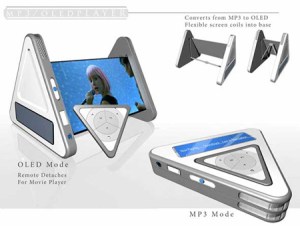
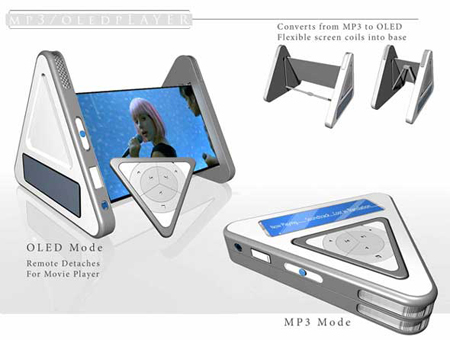
Designer Lisa Kohanski offers a futuristic design, perhaps not all that far off, for an MP3/video player. Yanko Design offers the following description of the device:
Tripod is not only a unique triangular MP3 player, but a movie player as well! To transform, turn your MP3 player upside down and pull the two halves apart while holding the release button. As the OLED screen uncoils, a hinge will unfold and lock, stabilizing the unit. Remove the MP3 control and it becomes the remote movie player remote. Speakers round the top triangle corner for optimum sound projection.
1 Comment | Cool Entries, Experience Design, Innovation | Tagged: Kohanski, OLED, Yanko Design | Permalink
Posted by Larry Irons
January 26, 2007
Skilful Minds first discussed feature bloat in mobile devices here. We have mentioned OpenMoko as a potential solution to experience design issues related to users controlling the seams of mobile devices as well as providing vertical applications to better fit user needs. Well, OpenMoko has finally been opened up to the public so that we can follow the process of developing and implementing innovative sofware on an open source mobile device. OpenMoko is based on the Linux kernel and, unlike other mobile devices using Linux, the applications for OpenMoko are open source.
You can see a video interview with Shawn Moss-Pultz . He is the product manager for First International Computer’s Mobile Communications group which produces the Neo 1973 phone, the initial hardware platform for OpenMoko. In OpenMoko the entire software stack is open to developers to come up with innovative applications.
Leave a Comment » | Experience Design, User Experience | Tagged: mobile experience, OpenMoko, user experience | Permalink
Posted by Larry Irons
January 9, 2007
I know, I know, you are probably saying “Can’t he talk about anything but seamful and seamless design?” Well, I’ll get off that topic soon. Yet, in the meantime, here are a couple of examples of how a seamless interface to the user of a device is a seam for control by someone else. One basic point of those arguing for seamful design is that the user of the device, rather than the developer, is the agent whose control over the device needs maximizing by designers. Those who contend the goal of a seamless interface is a well-intentioned effort to relieve those using ubiquitous mobile devices from information overload often fail to mention up front that all connected devices provide seams of control. You might say that proponents of seamful design are the Libertarians of experience design, contending that control over the agency of any device belongs with the person who uses it, especially if they own it. Read the rest of this entry »
Leave a Comment » | Experience Design, Ubiquitous Computing, User Experience, Web 2.0 | Tagged: OpenMoko, OTA, seamful, seamless, Ubiquitous Computing | Permalink
Posted by Larry Irons
January 7, 2007
As Part 2 in this series indicated, my interest in ubiquitous computing started with the sort of issues raised by Lucy Suchman’s initial research on artificial intelligence applications, specifically expert systems. I’ve been waiting to read Lucy’s second edition of Plans and Situated Actions, titled Human-Machine Reconfigurations before finishing this series of entries. It is an interesting read, and I think several themes introduced by Suchman’s most recent work nicely highlight the contributions in Adam Greenfield’s Everyware.
Everyware offers a number of interesting and provocative insights into the phenomena of ubiquitous computing. The most sensible, and provocative, insight offered by Greenfield relates to whether the design of ubiquitous computing needs to aim for seamless interaction with people using connected devices, or whether a rigorous focus is needed on how to make seamful interaction the guiding design practice. Read the rest of this entry »
Leave a Comment » | Experience Design, Ubiquitous Computing, User Experience | Tagged: Artificial Intelligence, Everyware, machine learning, Ubiquitous Computing | Permalink
Posted by Larry Irons
January 3, 2007
Part 1 promised that Part 2 would discuss Greenfield’s Everyware. However, before we get to that discussion, a few considerations on Moreville’s Ambient Findability are needed. The discussion of Moreville’s book will make clear the contributions offered in Everyware.
Greenfield and Moreville express skepticism about the ability of artificial intelligence to solve basic problems related to ambient findability and Everyware, what Greenfield terms ambient informatics. As more and more ordinary devices are available for people to engage as they go about routine activities, the sheer challenge of finding the right device among those available to support an activity promises to develop into a significant hurdle. Both authors recognize the challenge. Yet, Greenfield and Moreville both fail to discuss straightforwardly the challenges faced by attempts to manage relationships between connected devices. Read the rest of this entry »
Leave a Comment » | Ubiquitous Computing, User Experience, Web 2.0 | Tagged: Artificial Intelligence, Everyware, Findability, Ubiquitous Computing | Permalink
Posted by Larry Irons
December 17, 2006
I read Adam Greenfield’s Everyware in August of this year, but haven’t written anything about it yet. I like the book, a lot. It led me to think again about a number of issues that I kind of put to the side over the last two decades as I’ve made a living as a knowledge worker, i.e. methods analyst, technical writer, multimedia developer, Professor of Communication, web designer, human capital manager, e-Learning researcher, learning architect, customer experience designer. However, Adam’s book made an impression on me initially, more because of things that I experienced in the late 1980s and early 1990s than for its relevance today, though it is extremely relevant to today’s challenges in relating human experience to the ubiquitous nature of computing technology. Read the rest of this entry »
2 Comments | Ubiquitous Computing, User Experience, Web 2.0 | Tagged: Artificial Intelligence, Everyware, Findability | Permalink
Posted by Larry Irons
October 10, 2006
From the first time I heard the work folksonomy I really liked the concept. The idea of building meta-data about places and things from the people who experience them really seems cool if you have an appreciation for sociability. However, I must say that the new twist on the concept offered by [murmur] provides people moving through places with thick descriptions rather than tagged information aggregated by collaborative filtering software. [murmur] is available in Toronto, San Jose, Vancouver, and Montreal. It is really an oral history project that allows you to access stories about places you pass through while you are there. But, the basic concept is much more than oral history. Read the rest of this entry »
1 Comment | v-Tags, Web 2.0 | Tagged: folksonomy, murmur, tags, visual tags, Web 2.0 | Permalink
Posted by Larry Irons
September 29, 2006
Yanko Design just showcased an intriguing design for a futuristic ring that exchanges information.
This product is designed to exchange basic information with new people in the first meeting by shaking hands….When people first meet and shake hands, the rings on the fingers get close enough to operate. The rings exchange their users information and stores them while they are shaking hands. So, the more people they meet, the more information they have. When the users browse through the people they meet, the card displays their basic information that was stored in the ring. The power source is provided from human temperature, so it doesn’t need any plug.

Treat yourself and go on over to look at the full-size images in Hideaki Matsui’s design.
It is worth the trip!
Leave a Comment » | Cool Entries, Experience Design | Tagged: tangible computing, Ubiquitous Computing, Web 2.0 | Permalink
Posted by Larry Irons
July 9, 2006
Rachel Jones, founder of the UK user-centered design company Instrata reports in Usability News on research her company recently finished asking what mobile phone users in the United Kingdom and Europe over the age of 30 want in a product. She makes the following observations about the customer segments for mobile phones above the age of 30:
Some are technically advanced, using a range of other gadgets but with purpose and quality as their motivation. They primarily want to use their mobile for calls and texts, e.g. businesspeople communicating on the move – and would choose a simpler model over others, but only if it has the right look. They won’t use a mobile camera unless the photo quality is equivalent to their digital cameras, and so convergence will only be of interest if quality is undiminished.
Others may be uncomfortable with technology, but don’t want to advertise the fact. They often give up on mobiles, which come to live at the back of the desk drawer or in the bottom of the handbag.
Many potential customers just wish for a phone that is user friendly, and rate this as much more important than any other factor. Many in all groups have had free upgrades to phones that no longer suit their needs, and which have then caused unanticipated frustrations.
As Jones correctly notes, many customers want increasingly sophisticated functions in their mobile phones. Yet, as she adds, ” When phones are created for the older market they do not have the styling or personalisation that these consumers want, or if they do, the marketing concentrates on what they feel are the more patronising aspects of improved usability instead of innovation.” In other words, customers over 30 want mobile phones with simple features that provide a pleasant look and feel.
Jones research raised my interest because it provides insight into a basic change occurring in the mobile phone market. Read the rest of this entry »
Leave a Comment » | Experience Design, User Experience | Tagged: Experience Design, MVNA, MVNO | Permalink
Posted by Larry Irons
June 9, 2006
I started reading The Persona Lifecycle by John Pruitt and Tamara Adlin over the past week, all 700 plus pages. The book provides a detailed overview of how to use personas, though mostly focused on interactive applications such as web design and software. I cannot review the whole book here, largely because of its length, but also because it does not seem like a book the authors designed for people to read through. It is more like a nicely woven set of concepts, practical insights, and toolkits around the topic of personas. In addition, it provides five original contributions, as individual chapters, by well-known authorities in user centered design. Read the rest of this entry »
1 Comment | Brands, Customer Experience, Experience Design, User Experience | Tagged: Customer Segmentation, Experience Design, Persona | Permalink
Posted by Larry Irons
March 26, 2006
Yesterday I received my copy of the Working Knowledge series from Harvard Business School. Larry Huston and Nabil Sakkab, both executives for P&G., wrote one of the articles, “P&G’s New Innovation Model.” The authors note that, by the year 2000, the challenge for P&G of growing organically by 4 to 6 percent each year meant the equivalent of building a $4+ billion business annually. They note that P&G was able to meet those top-line growth challenges in the past by building global research facilities and retaining the world’s best talent. Yet, the authors indicate that by the year 2000 P&G recognized it could not support the necessary growth using the “invent-it-ourselves” model, what I’ve previously termed self-oriented innovation. Read the rest of this entry »
1 Comment | Customer Communities, Innovation | Tagged: Innovation, Self-Orientation | Permalink
Posted by Larry Irons
February 2, 2006
A folksonomy results from distinct ways of organizing cultural categories developed from the tags, keywords, people use to describe specific content, or services, on the web. The emphasis in folksonomies is on organizing data, not making friends. As Ellyssa Kroski notes, a key difference between Flickr, 43Things, and del.icio.us, when compared to LinkedIn and Friendster, is that the former are focused on organizing data from individual users for the user public, with social relationships arising as users share and seek out others of like mind. The approach is attracting numerous efforts to make accessing information needed to find things easier. I recently came across The Art Museum Community Cataloging Project, called Steve for short. It is an effort to use folksonomies to help visitors find art in museums. Read the rest of this entry »
3 Comments | Customer Communities, Social Networks, Web 2.0 | Tagged: social networking, Web 2.0 | Permalink
Posted by Larry Irons
January 4, 2006
Interfaces are not what they used to be. The computer-human interface is both more and less than it was a few years ago. Interfaces are not only, or even primarily, a screen anymore. Yet, screens remain important to most design efforts, even though interfaces are increasingly part of the environment itself. As John Thackara and Malcolm McCullough both recently pointed out, entire cities are developing into user interfaces as ubiquitous computing environments expand.
Peter Morville has outlined one approach to the challenges posed by ubiquitous computing for people who need to go places or find things. He calls it “ambient findability”: “…a fast emerging world where we can find anyone or anything from anywhere at anytime” (p. 6). Read the rest of this entry »
1 Comment | Experience Design, Social Networks, User Experience, v-Tags, Web 2.0 | Tagged: Experience Design, Findability, visual tags | Permalink
Posted by Larry Irons
January 3, 2006
“The best companies find ways to tune in to customers’ voices every day,” The Three “Ds” of Customer Experience…
Focusing on how to engage customers in dialogue, how to converse with customers is among the greatest challenges, and opportunities, facing companies today. Conversing with customers requires a focus on their experience with existing products and services as well as the design of new ones. It means developing business processes to deliver products and services that are not self-oriented, but customer-oriented; not inside-out, but outside-in.
Customer Experience Management (CEM) is a term used by many people to describe the methods for developing customer-orientation instead of self-orientation in business processes. CEM is one of those terms offering something to lots of different people. As a result, it is sometimes confused with the very services it claims to offer management advice on applying. A recent series of posts on LivePath provide an interesting discussion on what makes CEM different from CRM, User Experience Design, and Experiential Marketing. If you employ these buzz words in describing the services your company offers, I strongly encourage a close reading of these posts by Leigh Duncan. Although I might quibble with some of the distinctions made within each functional area of CEM that Leigh outlines, the overall strategy for making sense of what CEM offers is sound.
Share this post…
: : : : : : : : : :
Leave a Comment » | Customer Communities, Customer Experience, Experience Design, Innovation | Tagged: CEM, CRM, Customer Experience Management, user experience | Permalink
Posted by Larry Irons
November 14, 2005
Thanks to Putting People First, I found Aria magazine today. Aria is a magazine dedicated to Emotional Geography. The inspiration for the magazine comes from Professor Giuliana Bruno of Harvard, who wrote Atlas of Emotion. Mark Vanderbeeken at Putting People First wonders if Aria magazine is a brand strategy for Nokia, since Nokia is the only advertiser in the magazine. The magazine draws inspiration and trend examples from the qualitative research consultancy Future Concept Lab. Whether Nokia is involved is unknown. However, the approach of an Emotional Geography could prove useful in the branding efforts of companies like Nokia. Giuliana Bruno’s work provides a point of view that asserts the close connection between communication technology and tactile experience, especially the notion of “staying in touch.”
Cinema has laid the foundation upon which the current communication technologies have developed and strengthened: the possibility of reaching places and people without really moving. The term “con-tact” stands for the need of human beings to stay in touch, and it does, indeed, emphasize “tact”‹that tactility favored by the desire for closeness. The new terminology of communication indicates better than anything else how something which at first appears to be aseptic and abstract is, now more than ever, tactile… At first, there is always a moment in which you fear that the medium itself can get the “upper-hand” and overwhelm the human spirit. But it is not so. Time has shown, again and again, that desire does not die. Once you master the medium, that you tangibly do is continue to look for other ways to keep contacts.
Leave a Comment » | Experience Design | Tagged: Experience Design | Permalink
Posted by Larry Irons


 Skilful Minds