August 27, 2009
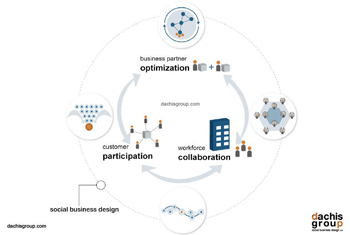
Source: David Armano "Social Business by Design"
My first corporate position carried the title Methods Analyst, working for a large billing center serving a telephone company. One of my main tasks in that role involved learning how other employees performed their work and documenting it. On each project I typically spent several hours observing people work (what some today call rapid ethnography or guerilla ethnography) and then did in-depth interviews of the people I observed. Usually, at the end of my observation, I took responsibility for doing the work for a brief time under their watchful eye. In some sense you could say my work required me to continuously cross train in other people’s work, analyze the process, and write it up in a technical document. The main insight I took away from that experience was an appreciation for the importance played by empathy in effective collaboration.
First off, collaboration isn’t just about people sharing information to achieve common goals. Collaboration is about people working with other people to achieve common goals and create value. Advocates of Enterprise 2.0 sometimes make the fundamental mistake of arguing that collaboration is really only about achieving business goals, leaving the implication that incorporating social software into the work flow of organizations is sufficient. Even though goal-orientation is a big part of collaborating, collaboration requires more to achieve goals effectively. It requires shared experience. As Dev Patnaik and Evan Rosen recently noted, empathy and collaboration go hand in hand.
Read the rest of this entry »
 16 Comments |
  Brands, Change Management, Collaboration, Customer Experience, Enterprise 2.0, Ethnography, Social Business Design, Social Media | Tagged: Collaboration, Customer Experience, Dachis Group, Enterprise 2.0, Social Business Design, Social Media, social network |
  Permalink
 Posted by Larry Irons
August 19, 2009

Update:
The presentations from Transform are now available online. Take some time and listen to these videos if you are in the least interested in how to transform health care.
Health care is increasingly gaining attention as an area in which innovation involves informal learning, and many of the other topics that go along with using Web 2.0 to engage people. The current debates at the national level about changing health insurance carry with them an underlying focus on innovation in the design and delivery of healthcare services, an area referred to for several years as Health Care 2.0. And the Mayo Clinic is always at the top of the list when innovation is discussed in healthcare. So, it isn’t a surprise that the Mayo Clinic is sponsoring a symposium in September focusing specifically on innovating health care experience and delivery.
The symposium includes a number of segments with intriguing topics. However, the two I find most interesting are the Redefining Roles and the Content, Community, Commerce, Care, & Choices segments. It looks like a promising experience for those fortunate enough to attend.
Redefining Roles
This segment will introduce the emerging roles of disruptive technology and business model innovations in making products and services in health care affordable and accessible. It will touch upon the evolution of health care delivery systems — particularly hospitals — from geographically-centered and costly entities to decentralized and more focused operations. Participants will be introduced to emerging business models in health care, including facilitated networks — online communities of people who help to teach one another about how to live with their diseases. This segment will also explore the notion that health care can be designed to minimize the degree to which it disturbs peoples’ lives.
…
Content, Community, Commerce, Care, & Choices
Communities of people are sharing health care-related content online. This has come to be called “Health 2.0.” Individuals and organizations have built business ventures around sharing content. But what does it take for these models to evolve into reliable facilitators of wellness? How can these communities link with existing bricks-and-mortar care delivery systems in ways that help people in their journey to wellness? What are “microchoices” and how might they be more powerful than all of health care?
My interest in using communities to enhance the service experience goes back several years. I had not considered their application to health care services until recently when an associate pointed me to several hospitals using social media to connect with patients. It looks like a promising area for innovation and highlights the relevance of informal learning to health care services.
Thanks to Tim Brown at Design Thinking for the pointer to the Mayo symposium.
Posted by Larry R. Irons
Share this post…
 :
:  :
:  :
:  :
:  :
:  :
:  :
:  :
:  :
:  :
: 
2 Comments | Collaboration, Customer Communities, Experience Design, Innovation | Tagged: Collaboration, customer community, Experience Design, Health Care 2.0, Innovation, Web 2.0 | Permalink
Posted by Larry Irons
August 18, 2009
 The emergence of social media provides people inside and outside organizations with a way to actively speak about, speak to, and engage the product and service offerings of enterprises. Currently, 25% of search results for the World’s Top 20 largest brands are links to user-generated content and 34% of bloggers post opinions about products & brands. Enterprises, on the other hand, listen to, engage, and act on insights gained from social media.
A recent study of social media engagement by Ben Elowitz and Charlene Li covered the 100 largest brands and, among other conclusions, noted that,
One recurring theme throughout these case studies is that engagement cannot remain the sole province of a few social media experts, but instead must be embraced by the entire organization.
Channels, policies, processes, touch points and transactions are increasingly viewed as parts of the social experience organizations use to encourage employees in collaboration (also known as — Enterprise 2.0), and engage customers in conversation (also known as — social media) for the purposes of innovation and transformation of the business. The common goal of the ongoing discussion involves transforming business practices to incorporate social relationships into the value proposition to customers and other stakeholders.
Integrating engagement into enterprises is crucial to strategic efforts to use social software throughout an ecosystem, inside and outside the formal organizational hierarchy, as social business design. My contention is that such integration is most likely to succeed with a focused approach to informal learning. In my last post, Scalable Learning and Learnscapes in Social Business Design, I offered the following point.
The concept of learnscape is a useful framework for thinking about the strategic challenge to the range of learning activities occurring as companies attempt to create feedback loops between their brand experience and the functional areas of their enterprise, especially in regard to the multidisciplinary collaboration needed to make these efforts successful.
The concept of a learnscape, initially outlined by Jay Cross, focuses our attention on designing ecosystems to heighten the innovation and performance of people. I lay out some thoughts about learnscapes and shaping ecosystems below, using key concepts from the Dachis Group’s framework, initially discussed in an earlier post on HP’s WaterCooler project. I don’t claim these insights provide proven techniques for shaping enterprise ecosystems. But, I do think they point in a useful direction for those thinking about Enterprise 2.0 and social media strategy to keep in mind. Read the rest of this entry »
3 Comments | Collaboration, e-Learning 2.0, Enterprise 2.0, Learning Experience, Social Business Design, Social Networks, Web 2.0 | Tagged: brand, Collaboration, Dachis Group, e-Learning 2.0, Enterprise 2.0, Innovation, Learning Experience, learnscapes, social network, user experience, wiki | Permalink
Posted by Larry Irons
August 10, 2009
 About a month ago I read What Would Andrew Do?, an unbook by Jay Cross and friends. I’ve mentioned Jay’s work in previous posts dealing with elearning 2.0 and collaboration in informal learning. In particular, its important to remember that focusing on informal learning doesn’t mean we must disregard the relevance of formal learning because learning is never 100% formal or informal.
However, the term scalable learning probably does require a bit of clarification. After all, isn’t elearning supposed to scale to the size of the learning group and remain available when they need it, where they need it, as long as they are connected to the Web? Well, yes–and it does pretty much. Nevertheless, instructional designers too often fail to incorporate emergent learning requirements of the organization, the enterprise, into their learning architecture largely because the approaches used to evaluate learning content (whether elearning, blended, or instructor-led) do not incorporate assumptions about the larger ecosystem’s need for the co-creation of knowledge.
The concern for whether the learner is exposed to every thread of content in every course, and assessed for mastery of the information, tends to predominate design thinking about learning, and for compliance training sometimes this is required. However, too often, instructional design fails to focus on whether the learning scales to support the learner’s ability on-the-job to recognize a problem as a particular kind of problem, much less provide the ability to find the learning content that provides a solution.
I don’t intend to delve here into the minutiae of distinction possible between types of learning. Suffice it to say that when a learning architecture supports all types of learning along the range of formal, non-formal, and informal experience, it must design formal learning in small enough chunks to serve as resources for non-formal and informal learning activities. It also means that the knowledge created using non-formal learning (whether mentored or accomplished in collaboration with peers), or informal learning taken on its own, needs to become a performance resource in developing new formal learning content.
Jay contends that the performance challenges facing organizations are most aptly conceptualized as a learnscape, a concept initially articulated by John Seely Brown and Paul Duguid. In the August 2009 issue of Chief Learning Officer magazine, Jay offers the following synopsis.
Learnscapes are the factory floor of knowledge organizations. The “scape” part underscores the need to deal at the level of the learning environment or ecology…The “learn” part highlights the importance of baking the principles of sound learning into that environment rather than leaving it to chance.
John Hagel sees learnscapes as part of a global transformation of industrial society that he, John Seely Brown, and Lang Davison call the Big Shift: the move from institutions designed for scalable efficiency to institutions designed for scalable learning. Hagel’s thinking is relevant since, as I explain below, Jay uses the Push/Pull distinction to demarcate formal and informal learning. The basic insight is conveyed by Hagel, Brown, and Davison in their thoughts on Measuring the Big Shift:
Companies must move beyond their fixation on getting bigger and more cost-effective to make the institutional innovations necessary to accelerate performance improvement as they add participants to their ecosystems, expanding learning and innovation in collaboration curves and creation spaces. Companies must move, in other words, from scalable efficiency to scalable learning and performance. Only then will they make the most of our new era’s fast-moving digital infrastructure.
The participants that Hagel, Brown, and Davison refer to consist of consumers, customers, partners, and employees using social media to talk about, talk to, and engage the products and services, i.e. brands, that an enterprise markets. Don’t misunderstand the focus on performance in the discussion of scalable learning. It isn’t about the traditional focus on efficiency, pursuing ever leaner processes for the sake of officially recognized best practices. Rather, the focus is on creating the knowledge needed to adapt to emergent challenges and manage the flow of that adaptation through the enterprise’s ecosystem. For learning architecture it begins with understanding the importance of keeping the focus on distinctions between push and pull learning.
Read the rest of this entry »
3 Comments | Change Management, Collaboration, e-Learning 2.0, Enterprise 2.0 | Tagged: Big Shift, elearning 2.0, Enterprise 2.0, informal leaning, learnscapes, Push/Pull, socia network, Social Business Design, social computing, unbook | Permalink
Posted by Larry Irons
July 15, 2009

Social Media Snake Oil?
Does your organization approach using social media in its business as something to fear or as something to evangelize? Several recent observers note that incorporating social media into business involves changing the culture underlying communication patterns and decision-making in many large organizations.
Amber Naslund, for instance, tells us that adopting social media means changing the mindset on how to do business. In particular, she says using social media in business means “giving your customers a visible, valuable say in how you do things, and having the faith that doing that is just good business.” On the other hand, Caroline Dangson, of IDC contends enterprises aren’t yet sold on social media and that “there are executives still fearful of the transparency that comes with the social media spotlight.” Specifically, Caroline says that,
Corporate culture has everything to do with adoption of social media. I believe the number one factor preventing full adoption of social media is the lack of executive trust in employees. This culture is about control and creates a workplace of silos. This type of workplace is not set up to be social and the silos are barriers to worker productivity.
So, here social media sits, between fear and faith. Needless to say, the truth about social media’s implications for business design lies somewhere in the middle. The fact of the matter, as Todd Defren tells us, is that we need to begin seriously discussing “how Social Media Thinking will impact the greater whole of the company.”
As noted in an earlier post, keeping in mind the distinctions between formal, process-oriented organization and informal, practice-based organization is crucial in thinking through the collaborative challenges posed by social software for enterprises and designing for the experiences supported. We can learn a bit about the complexity of the challenges involved by considering a recent framework offered on social business design by the Dachis Corporation team and discussing the way it relates to a recent report on an experiment in enterprise social media at the Social Computing Lab of HP Laboratories.
Read the rest of this entry »
8 Comments | Brands, Change Management, Collaboration, Innovation, Social Business Design, Social Networks, Web 2.0 | Tagged: Customer Experience, Enterprise 2.0, Experience Design, Social Business Design, Social Media, socialCRM, Web 2.0 | Permalink
Posted by Larry Irons
July 7, 2009
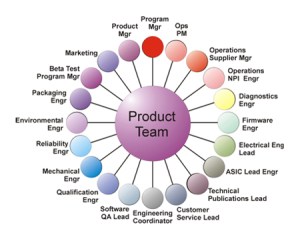
David Armano recently asked the question, Is the Hub and Spoke Model Adaptable? Anyone who ever worked on a project team in a large organization, especially corporate enterprises, probably recognizes the hub and spoke team design depicted in the graphic above. In this post I take a closer look at the hub and spoke design’s purpose in hierarchical, bureaucratic, organizations–the kind associated with industrial society. Our next post discusses how David answered his question and what an adaptable hub and spoke model implies for social business design.
Project management, typically consisting of one or more team leads clustered in the hub, considers the failure of any spoke’s functional work practices to align with approved best practices as evidence of process ignorance, a failure of competence in following the detailed process requirements in the team’s project plan, not a failure of the organization’s adaptive capability. The hub and spoke model’s basic idea is that a matrix-organization, consisting of cross-functional project teams, optimizes the traditional hierarchical organization by adding increased flexibility in responding to market demands for innovation in products and services, and maintaining adherence to a standard management process. However, as Rob Cross and Robert Thomas observe in their recent book, Driving Results Through Social Networks,
…most projects and processes are enabled by productive networks that form among some (but not all) team members in combination with relationships that bridge to key resources and expertise outside of the team.
In other words, much of the collaborative effort going into innovation projects also involves social networks that aren’t part of project teams. Instead, these networks emerge from relationships with others in the enterprise, or from outside friends and associates. Perhaps this is one of the reasons that some research into geographically distributed teams shows that on average, only 75% of the employees on any given distributed team agree about who is, and who is not, on their team. The challenge increases in importance as project teams form and disband more rapidly to manage risk and opportunity, thereby increasing the already fuzzy distinctions of formal organization, i.e. official teams, and informal organization, i.e. social teams.
Ross Mayfield summarized the point well in the following observation:
Process is “how work should be done.” And Practice is “how work is actually done.” When process fails (exceptions), people use practice to fix things. When process doesn’t exist, practice fills the void. While people don’t realize it when they engage in practice, they actually are tapping into community — an informal social network within or beyond the enterprise to discover expertise and get things done. The problem is that we haven’t had the tools to support good practice. The problem is that we haven’t developed the group memory around practice that creates institutional leverage. In fact, we still design organizations to prevent practice and cultures that hoard knowledge and communities.
I suggest that the real value of social business design comes from the promise it holds for enabling management practices to develop to deal with the following fact: Social networks do not respect organizational walls, they never did.
Shared experience, not just shared information, is fundamental to the social networks underlying collaboration and innovation. Many, if not most, employees don’t only need to get to know one another through reputation systems, like who people tag as possessing expertise. As Thomas Vander Wal continues to point out, comfort with one another is needed to develop a shared experience that encourages the open sharing of information.
Collaboration means getting to know that other employees possess expertise on this or that topic, but also developing comfort with one another by sharing significant symbols relating to self, family, friends, and social activities, thereby understanding one another as people. Shared experience with co-workers and customers is a key factor in innovative business practices. It is especially important to multichannel collaboration.
Read the rest of this entry »
23 Comments | Brands, Change Management, Collaboration, Experience Design, Social Business Design, Social Networks | Tagged: Change Management, Enterprise 2.0, Experience Design, project management, social business, social capital, social software stack, Web 2.0 | Permalink
Posted by Larry Irons
March 18, 2009

Social Software Stack
The title for this post is drawn from a recent assessment of SharePoint 2007 offered on Thomas Vander Wal’s bog, Personal InfoCloud. Thomas’ post, as always, offers a unique point of view on what Enterprise 2.0 consists and, specifically, how SharePoint measures up. He isn’t offering his own formal assessment as much as reporting the stories clients and potential clients shared with him over the past couple of years. The social software stack, in particular the difference between collective understanding and collaborative understanding, frames Vander Wal’s perspective.
Given SharePoint’s widespread use, and the growing interest in applying social media applications to collaboration challenges in organizations, Thomas’ discussion deserves wider attention. His overall impression is well summarized in the following point.
SharePoint does some things rather well, but it is not a great tool (or even passable tool) for broad social interaction inside [the] enterprise related to the focus of Enterprise 2.0. SharePoint works well for organization prescribed groups that live in hierarchies and are focussed on strict processes and defined sign-offs. Most organizations have a need for a tool that does what SharePoint does well.
This older, prescribed category of enterprise tool needs is where we have been in the past, but this is not where organizations are moving to and trying to get to with Enterprise 2.0 mindsets and tools. The new approach is toward embracing the shift toward horizontal organizations, open sharing, self-organizing groups around subjects that matter to individuals as well as the organization. These new approaches are filling gaps that have long existed and need resolution.
In other words, SharePoint works well for situations in which defined groups need to reach a collaborative understanding of project requirements, their role in achieving those objectives, and what success means for the project. It works less well in providing resources allowing people across the enterprise, and across teams or departments, to discover connections with others and develop social relationships for networking together in ways that meet both personal and organizational challenges.
Read the rest of this entry »
12 Comments | Collaboration, Enterprise 2.0, Social Media, Web 2.0 | Tagged: e-Learning 2.0, elearning 2.0, Enterprise 2.0, social networking, twitter, Web 2.0 | Permalink
Posted by Larry Irons
February 23, 2009
 Good service is one of those experiences most of us recognize when we get it. Much of the time though, a good service experience is as much a result of how learnable the provider makes its business processes, the context of the service, as it is the products and services themselves. I discussed this a couple of years ago in a post on the importance of a dialogue strategy for customer experience management. A dialogue strategy builds on the assumption that companies learn more from customers when customers learn from them. More recently I noted that,
The increasing maturity and diffusion of social media over the ensuing years makes it clear that a dialogue strategy provides a coherent framework for communications, whether addressing collaboration, innovation, marketing, sales, support, or branding. The key to the process is understanding customers, attracting them, engaging them, and learning from them to improve products and services, thereby strengthening your brand…
Strategists increasingly recognize that listening to customers, engaging them in dialogue, and acting on what is learned lies at the heart of experience design’s relevance to brands, customers, and social media.
These insights are relevant to the current shift in focus for experience design, from primarily emphasizing the design of products to also emphasizing the design of services, as exemplified in Peter Merholtz’s recent series in Harvard Business online. Okay, you may ask, how does this all relate to eLearning and learnability?
Read the rest of this entry »
2 Comments | Collaboration, Experience Design, Learning Experience | Tagged: business process, call center, Customer Experience, e-Learning, eLearning, elearning design, Experience Design, learnability | Permalink
Posted by Larry Irons
January 16, 2009
Social Networks that Matter
Without going into links to specific posts, I’ve noticed a trend among many blogs I try to keep up with over the past couple of years. I can’t count the number of times I’ve seen prominent bloggers post publicly about having to pare down the list of RSS feeds they read, or tweets they respond to. Since Peter Kim’s blog is the most recent instance of the trend I’ll use one of his recent posts as an example of what I mean. Peter noted that he increasingly hears an echo chamber across social media blogs in which the same content, case studies, anecdotes, etc. gets repeatedly posted and commented on. More cynical observers might contend that the complaints about information overload from influentials is a little like strutting in front of a crowd. Nevertheless, it is difficult to dispute the point that attention is a scarce resource on the Web. So is engagement.
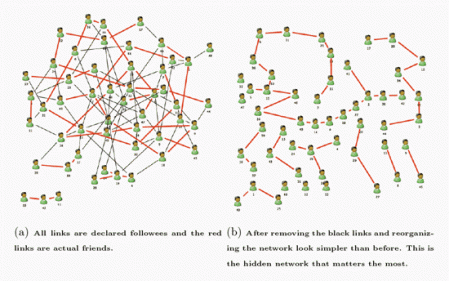
Ross Mayfield recently pointed to a study published by researchers at the Social Computing Lab of HP Laboratories that addresses the point succinctly by pointing to constraints on friendship in directed social networks such as Twitter. A directed social network is characterized by an absence of explicit reciprocity constraints, fifty people can follow one person without that person necessarily following any of them. First Monday’s most recent issue includes an article, Social Networks that Matter: Twitter under a Microscope, that reports on a study of Twitter users by Bernardo A. Huberman, Daniel M. Romero, and Fang Wu of HP Laboratories.
The authors analyzed data from 309,740 people using Twitter. They compared the network of interactions people actually engage in while using social computing technologies such as Twitter to the network of connections with whom one shares a social relationship. Networks of actual interaction are considered networks that matter by the authors.
By networks that matter we mean those networks that are made out of the pattern of interactions that people have with their friends or acquaintances, rather than constructed from a list of all the contacts they may decide to declare.
In other words, the research focused on reciprocity as well as connection in studying the social network of Twitter.
Read the rest of this entry »
13 Comments | Brands, Collaboration, Social Media, Social Networks, Web 2.0 | Tagged: Dunbar number, hidden network, influentials, reciprocity, Social Media, social network, social networks that matter, twitter, viral marketing, word of mouth | Permalink
Posted by Larry Irons
December 29, 2008
 As a previous post noted, assessing the business value of instructional design involves more than measuring the contribution of formal training to Level 3 and Level 4 outcomes defined in the Kirkpatrick model. Training professionals also need to understand and support informal learning processes, on-the-job and off, that enhance performance. Most of the learning that produces business value occurs informally, dealing with exceptions to formal business processes, yet most of the attention paid to learning is focused on formal training.
One can reasonably say that Web 2.0 applications, such as social software and social media, are changing the relationships between instructional designers and subject matter experts much like those between customer communities and product designers. Both increasingly involve situations of co-creation.
The emerging recognition of eLearning 2.0’s importance to enhancing collaboration and performance means that training professionals, especially instructional designers, can add value to their employer/client’s business by learning to facilitate and manage the co-creation of learning content with employees, or even customers. Anyone experienced in instructional design in recent years is familiar with the general challenge of co-creation whenever they use information content for course design ( slide shows, documents, etc.) that subject matter experts originally created as a resource for a presentation. The presentation content too often is substituted for observation and in-depth interviewing as a first step in analysis.
Such Rapid eLearning, though shifting content development toward the subject matter expert’s control, maintains the traditional role of training in incorporating design principles. The process of co-creation in eLearning 2.0, on the other hand, shifts control over development and distribution of learning content toward subject matter experts willing and able to share what they know, especially when they see other people who need to solve familiar problems.
Read the rest of this entry »
4 Comments | Collaboration, e-Learning 2.0, Innovation, Learning Experience, Social Networks | Tagged: co-creation, Customer Communities, e-Learning, e-Learning 2.0, eLearning, elearning 2.0, instructional design, kirkpatrick model, mzinga, social media measurement, social network, training, Web 2.0 | Permalink
Posted by Larry Irons
September 26, 2008
 Peter Kim offers an interesting observation on the way social networking relates to the qualities of Jeremy Bentham’s Panopticon and the insight offered by Michel Foucault that Bentham’s design served as an exemplar for organizational discipline in the industrial age. Peter notes that Bentham’s design made prisoners uncertain whether the prison guards were watching their behavior at any particular moment. He also points out that the design of modern cube farms in offices not only foster collaboration but also afford observation by managers and peers.
Read the rest of this entry »
5 Comments | Collaboration, Community 2.0, e-Learning 2.0, Enterprise 2.0, Social Media, Social Networks, Web 2.0 | Tagged: e-Learning 2.0, elearning 2.0, panopticon, social networking, Web 2.0 | Permalink
Posted by Larry Irons
September 18, 2008
 Ross Mayfield of SocialText recently pointed to a longstanding issue involving the relationship of organizational practices and organizational processes. He offered a discussion of distributed collaboration and community, specifically on the question of which organizational stakeholder is the most effective leader of community (internal and external) initiatives. Ross suggests that even though we may see the emergence of a Chief Community Officer to align and coordinate internal and external communities, communities are more likely to arise around organizational processes as 360 degree process communities.
In my view, approaching distributed collaboration from the standpoint of community alone, especially communities internal to the enterprise, is overly restrictive. Collective understanding and collaborative understanding, as Thomas Vander Wahl makes clear, are different parts of what he refers to as the social sofware stack. Without getting overly picky, let me agree with Ross’ point that the development of internal communities in enterprises will most likely occur around the way process owners manage routine work and its exceptions. Nevertheless, the distinction Ross makes, following Mike Gotta, about the difference between processes (how work is supposed to get done) and practices (how work actually gets done) really indicates a need to keep in focus the range of connections and interactions that social software enables.
Read the rest of this entry »
9 Comments | Collaboration, Community 2.0, e-Learning 2.0, Enterprise 2.0, Innovation, Social Media | Tagged: Collaboration, Community 2.0, Enterprise 2.0, Social Media, social software, Web 2.0 | Permalink
Posted by Larry Irons
July 14, 2008
At least since publication of the Cluetrain Manifesto, with its basic point that markets are conversations, the importance of customers, online and off — but especially those online, to innovation gained widespread recognition. Pointing out the importance of customer communities to sustaining innovation is not exactly a new insight. In recent years the term co-creation emerged to describe the process, whether applied to established companies or start-ups. However, understanding what leads customers to engage in co-creation is important. A story at Nokia Conversations points to a recent study sponsored by Nokia Beta Labs that offers a profile of the customers active in their community, framing the relationship as follows:
While on one side it seems cheap to release unfinished goods and ask for help. But at the same time, it’s amazing to involve eager customers who not only make the product even better than if we did it alone, but are all lined up to take the product they helped make… Read the rest of this entry »
1 Comment | Collaboration, Customer Communities, Innovation | Tagged: co-creation, Customer Communities, Innovation | Permalink
Posted by Larry Irons
July 8, 2008
Screencasts are effective ways to share ideas, images, concepts, experiences, and a range of information for a variety of purposes including eLearning, collaborative problem solving, or just fun. I just ran across a new technique for doing screencasts called a Flowgram. Eric Schonfeld over at TechCrunch describes it as,
…a full-screen player with what appears to be a screencast with a voiceover. Except that you can control the pages by scrolling up and down, watching any videos that might be on the page, or clicking on the live links (which takes you out of the Flowgram to that Website, but if you hit the back button it picks up where it left off). You can also add comments and share the Flowgram via a widget…It’s an interactive screencast, a way to synthesize the Web by pulling different pieces together The voiceover acts as the glue. It can be used for slide shows, travel guides, tutorials, sales pitches, or just to explain something to a friend.
I’ve signed up for the private beta access program so I can build a few Flowgrams of my own to get a better sense of how this tool compares to applications like Captivate or Camtasia. After briefly interacting with several of the Flowgrams available it looks quite promising. I like the ability to scroll pages as well as play videos embedded in pages presented in the Flowgram. I’m not sure why the developers decided to navigate out of the Flowgram when you click on a link that takes you to a page outside the Flowgram, rather than opening a window to view it, but when you click the back arrow the flow of the Flowgram seems to pick back up where you left it. Take a look at Flowgram for an overview.
Share this post…
: : : : : : : : : :
4 Comments | Collaboration, Cool Entries, e-Learning 2.0, Innovation, Web 2.0 | Tagged: Collaboration, flowgram, Web 2.0 | Permalink
Posted by Larry Irons
July 7, 2008
Do you know who is on your team? It seems like an easy question for people who work in large corporations to answer. Reviewing Socialtext People recently led me to remember an interesting study I read a few years ago that reported rather surprising findings with significance for Enterprise 2.0, and to the lead-in question above. The study, largely ignored in the social networking literature, pointed to a clear limitation to collaboration in national and global corporations that organize teams geographically distributed.
Mark Mortensen and Pamela Hinds published a chapter titled, “Fuzzy Teams: Disagreement in Distributed and Collocated Teams”, in an edited collection called Distributed Work way back in 2002. The book itself contains an interesting range of studies on the challenges involved in organizing work across members of geographically distributed teams. However, it seems to me that Fuzzy Teams offers a key insight into the way Enterprise 2.0 applications, especially wikis, help to meet challenges in organizing distributed work that are often overlooked. Read the rest of this entry »
5 Comments | Collaboration, Enterprise 2.0, Innovation, Web 2.0 | Tagged: boundary spanning, distributed work, Enterprise 2.0, wikis | Permalink
Posted by Larry Irons
June 30, 2008
As a member of the boomer generation, a recent post by Stewart Mader on the use of Enterprise 2.0 at Wachovia caught my attention because it relates to a range of ongoing discussions on the relationship of age and innovative uses of technology in supporting collaboration.
Stewart points approvingly to a recent InformationWeek article on Wachovia’s use of wikis, blogs, and social networking to develop mutual mentoring between younger workers and senior staffers. Wachovia is assigning younger staffers to mentor senior staffers about the benefits of using collaborative networks. However, Stewart goes on to qualify the point of such mentoring with the following insight:
We often talk about how the millennial generation has an advanced grasp of these social and collaborative tools, but just half of the story in my opinion. I see enterprise 2.0 tools not as the exclusive domain of youth, but as a better connector for multiple generations, so that wisdom, tacit knowledge, and business know-how from the experienced can be shared with younger workers.
The point is bolstered by recent research, though with a couple of crucial caveats. Read the rest of this entry »
Leave a Comment » | Collaboration, Enterprise 2.0, Innovation, Web 2.0 | Tagged: digital divide, Enterprise 2.0, Millenials, Web 2.0, wiki | Permalink
Posted by Larry Irons
June 28, 2008
Wikis are largely about creating, organizing, and sharing knowledge. Most people think of textual and static graphic information created, organized, and maintained by groups of people when they consider what makes up a wiki. The integration of visualization tools is one of the more interesting developments in wikis recently though. As an example, the Thinkbase tool provides an ability to visually navigate and explore Freebase, an open, shared database of the world’s knowledge. The Thinkbase Blog is a good resource for learning about Thinkbase.
In fact, John Hosking recently provided an overview of how to use visual wikis. Read the rest of this entry »
7 Comments | Collaboration, Enterprise 2.0, Innovation, Web 2.0 | Tagged: Enterprise 2.0, visual wiki, Web 2.0 | Permalink
Posted by Larry Irons
April 30, 2008
Thomas Vander Wal recently offered an interesting discussion of how collective understanding and collaborative understanding differ, and why those differences are significant to social software, specifically in relation to folksonomy. Thomas’ concern is that many observers, and he points to the Wikipedia entry for folksonomy specifically, conflate collective understanding and collaborative understanding when considering folksonomy. He notes that, even though the two terms are similar, their differences manifest as distinct capabilities in social software.
…the term folksonomy was coined to separate tagging done in a collective manner (each individual’s contribution is held separate and collected or aggregated to build a fuller understanding, as the tagging is done by and from the individual reading the media for their own retrieval and is also share out with others). Collaborative tagging does take place and there is a need for it in certain situations, but it is not folksonomy.
First, Thomas makes a key point that remains unspoken when many people write about social software. Read the rest of this entry »
2 Comments | Collaboration, Enterprise 2.0, Innovation, Social Networks, Web 2.0 | Tagged: Collaborative Tags, Collective Tags, Enterprise 2.0, The Long Tail | Permalink
Posted by Larry Irons



 Skilful Minds