An MP3 Player for the Future

January 27, 2007

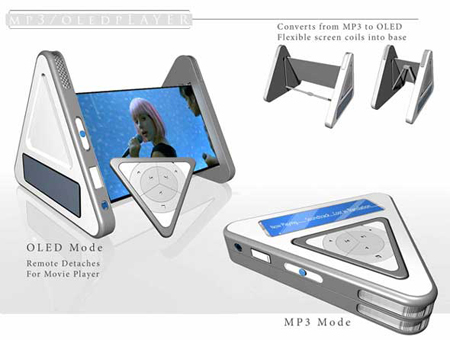
Designer Lisa Kohanski offers a futuristic design, perhaps not all that far off, for an MP3/video player. Yanko Design offers the following description of the device:

Tripod is not only a unique triangular MP3 player, but a movie player as well! To transform, turn your MP3 player upside down and pull the two halves apart while holding the release button. As the OLED screen uncoils, a hinge will unfold and lock, stabilizing the unit. Remove the MP3 control and it becomes the remote movie player remote. Speakers round the top triangle corner for optimum sound projection.

OpenMoko and the Mobile Experience

January 26, 2007

Skilful Minds first discussed feature bloat in mobile devices here. We have mentioned OpenMoko as a potential solution to experience design issues related to users controlling the seams of mobile devices as well as providing vertical applications to better fit user needs. Well, OpenMoko has finally been opened up to the public so that we can follow the process of developing and implementing innovative sofware on an open source mobile device. OpenMoko is based on the Linux kernel and, unlike other mobile devices using Linux, the applications for OpenMoko are open source.

You can see a video interview with Shawn Moss-Pultz . He is the product manager for First International Computer’s Mobile Communications group which produces the Neo 1973 phone, the initial hardware platform for OpenMoko. In OpenMoko the entire software stack is open to developers to come up with innovative applications.


A function, a seam, or a point of control?

January 9, 2007

I know, I know, you are probably saying “Can’t he talk about anything but seamful and seamless design?” Well, I’ll get off that topic soon. Yet, in the meantime, here are a couple of examples of how a seamless interface to the user of a device is a seam for control by someone else. One basic point of those arguing for seamful design is that the user of the device, rather than the developer, is the agent whose control over the device needs maximizing by designers. Those who contend the goal of a seamless interface is a well-intentioned effort to relieve those using ubiquitous mobile devices from information overload often fail to mention up front that all connected devices provide seams of control. You might say that proponents of seamful design are the Libertarians of experience design, contending that control over the agency of any device belongs with the person who uses it, especially if they own it. Read the rest of this entry »


Everyware, Findability, and AI (Part 3)

January 7, 2007

As Part 2 in this series indicated, my interest in ubiquitous computing started with the sort of issues raised by Lucy Suchman’s initial research on artificial intelligence applications, specifically expert systems. I’ve been waiting to read Lucy’s second edition of Plans and Situated Actions, titled Human-Machine Reconfigurations before finishing this series of entries. It is an interesting read, and I think several themes introduced by Suchman’s most recent work nicely highlight the contributions in Adam Greenfield’s Everyware.

Everyware offers a number of interesting and provocative insights into the phenomena of ubiquitous computing. The most sensible, and provocative, insight offered by Greenfield relates to whether the design of ubiquitous computing needs to aim for seamless interaction with people using connected devices, or whether a rigorous focus is needed on how to make seamful interaction the guiding design practice. Read the rest of this entry »


Everyware, Findability, and AI (Part 2)

January 3, 2007

Part 1 promised that Part 2 would discuss Greenfield’s Everyware. However, before we get to that discussion, a few considerations on Moreville’s Ambient Findability are needed. The discussion of Moreville’s book will make clear the contributions offered in Everyware.

Greenfield and Moreville express skepticism about the ability of artificial intelligence to solve basic problems related to ambient findability and Everyware, what Greenfield terms ambient informatics. As more and more ordinary devices are available for people to engage as they go about routine activities, the sheer challenge of finding the right device among those available to support an activity promises to develop into a significant hurdle. Both authors recognize the challenge. Yet, Greenfield and Moreville both fail to discuss straightforwardly the challenges faced by attempts to manage relationships between connected devices. Read the rest of this entry »