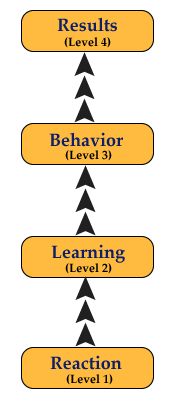
Kirkpatrick Model
I recently attended a meeting of the St. Louis Chapter of the American Society for Training and Development (ASTD) to listen to a presentation on the Kirkpatrick model of training assessment, offered by Jim Kirkpatrick, the son of the model’s creator — Don Kirkpatrick. Jim’s major point was that most training departments fail to measure learning outcomes at Levels 3 and 4 of the model. Without detailing the Kirkpatrick model’s four levels of analysis, the following are Jim’s definitions:
Reaction: involves what training participants thought of the training
Learning: the knowledge, skills, and attitudes gained through the training
Behavior: the degree participants apply what they learned on the job
Results: the business results gained
Suffice it to say that the model provides a unique framework on how to assess the learning outcomes of training. However, practitioners are prone to overlook a key issue in measuring learning. I previously noted the following about the Kirkpatrick model.
It is not a stretch to contend that Level 4 measurement is as much about organizational learning and change management as it is about individual learning. In the e-Learning Guild survey on measurement practices, Roy Pollock characterizes this situation as the “Catch-22” for training and development. He notes that, “assessment of on-the-job application and results is as much or more an assessment of the transfer climate…as it is of the quality of the instruction” (p. 167).
Based on what I heard from Jim Kirkpatrick as well as Nick Denardo, a presenter from Edward Jones’ strategic learning services group, the point about organizational learning also applies to Level 3 measurement, to the extent that existing organizational practices either facilitate or impede application of competencies and sharing of knowledge learned from formal training, whether on-the-job, or just informally.


 Posted by Larry Irons


 Skilful Minds